Rocket Track Rocket Sled (RTRS) Strengthens India’s Fighter Pilot Safety Framework
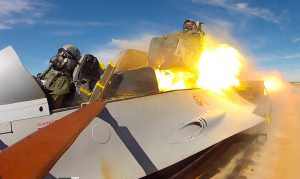
Context :The Defence Research and Development Organisation (DRDO) recently conducted a successful high-speed test of a fighter aircraft escape system using the Rocket Track Rocket Sled (RTRS) facility. This strategic achievement marks a major milestone in India’s indigenous defence capability, directly strengthening the framework for pilot survivability during emergencies.
The successful dynamic ejection test conducted using the Rocket Track Rocket Sled (RTRS) at the Terminal Ballistics Research Laboratory (TBRL), Chandigarh, marks a major technological achievement for India’s defence research ecosystem. This complex test places India among a small group of nations with advanced, fully indigenous escape system testing capabilities, significantly enhancing fighter pilot safety and strategic self-reliance.
What is the Rocket Track Rocket Sled (RTRS)?
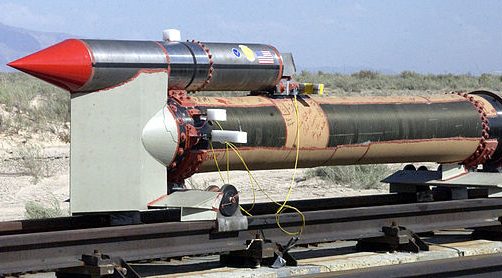
The Rocket Track Rocket Sled (RTRS) is a sophisticated ground-based high-speed testing system that uses solid propellant rocket motors to accelerate a sled-mounted test article along precision-engineered rail tracks. In this test, the RTRS achieved controlled velocities of up to 800 km/h, closely replicating real-flight conditions.
Key Functions of RTRS:
-
Flight-like Simulation: The Rocket Track Rocket Sled (RTRS) replicates extreme aerodynamic forces encountered by fighter aircraft during high-speed emergencies.
-
Realistic Test Article: The sled carried a system integrated with the forebody of the indigenous Light Combat Aircraft (LCA), ensuring direct relevance to India’s frontline defence platforms.
-
Data-Driven Validation: Instrumented anthropomorphic test dummies, fitted with advanced sensors, captured critical data on accelerations, loads, and rotational forces—essential for certifying the safety and reliability of the escape system.
Why Dynamic Ejection Testing Matters
Pilot escape systems such as ejection seats and canopy severance mechanisms are among the most safety-critical components of a combat aircraft. Their performance can determine pilot survivability in life-threatening scenarios, including zero-speed, high-speed, supersonic, or inverted flight conditions.
 Dynamic vs Static Testing
-
Static Tests: Conducted at zero speed or zero altitude, these tests validate basic functionality but fail to account for aerodynamic loads.
-
Dynamic Tests: Enabled by the Rocket Track Rocket Sled (RTRS), dynamic tests are the ultimate benchmark for escape system certification. They simulate real-flight conditions where inaccurate sequencing—off by even milliseconds—can expose pilots to severe injuries due to extreme forces.
Strategic Significance for Defence Indigenisation
The successful demonstration of Rocket Track Rocket Sled (RTRS) capability represents a critical milestone in India’s pursuit of ‘Aatmanirbharta’ (self-reliance) in defence.
Key Strategic Benefits:
-
Reduced Foreign Dependence: Earlier, India relied on expensive overseas facilities for dynamic ejection certification. The Rocket Track Rocket Sled (RTRS) eliminates this reliance.
-
Faster Development Cycles: Indigenous testing shortens development, validation, and upgrade timelines for ejection systems across current and future fighter platforms.
-
Significant Cost Savings: In-house RTRS testing costs are estimated to be four to five times lower than comparable foreign trials.
-
Strengthening the LCA Programme: The RTRS test focused on the LCA airframe, reinforcing India’s commitment to fully indigenous design, certification, and enhancement of its flagship fighter aircraft.
The in-house capability provided by the Rocket Track Rocket Sled (RTRS) ensures that India can continuously meet global safety standards for its combat aircraft with sovereign control over critical testing processes, thereby strengthening the entire aircrew recovery framework.
Know more about DRDO’s defence work.
Subscribe to our Youtube Channel for more Valuable Content – TheStudyias
Download the App to Subscribe to our Courses – Thestudyias
The Source’s Authority and Ownership of the Article is Claimed By THE STUDY IAS BY MANIKANT SINGH