Vehicular Emissions: Rising Early-Winter Pollution and Policy Response
Vehicular Emissions: Rising Early-Winter Pollution and Policy Response
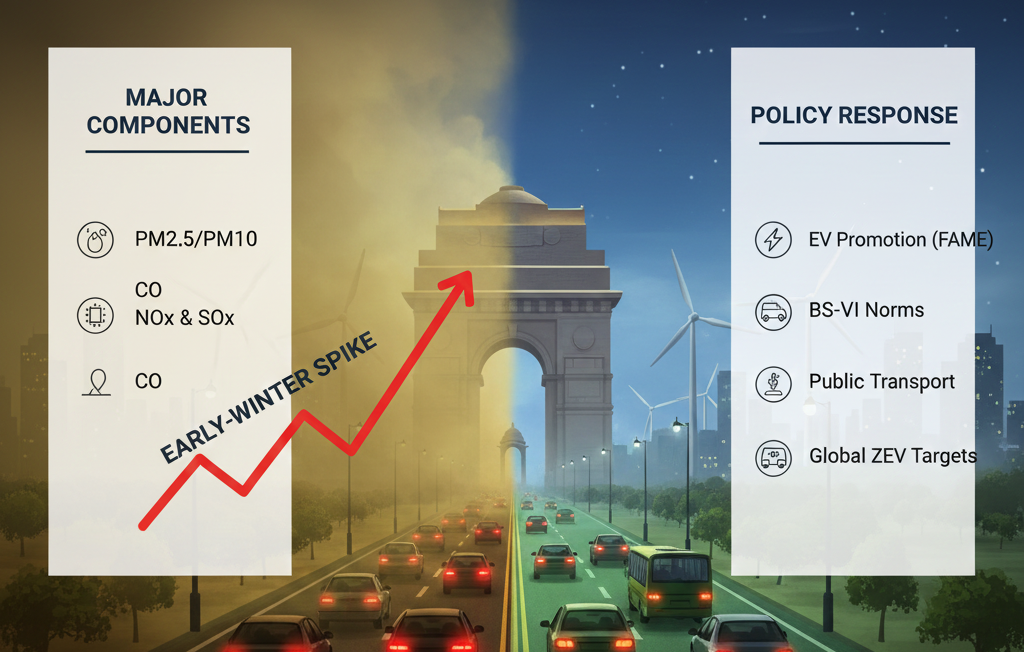
Context: A new Centre for Science and Environment (CSE) analysis has flagged a sharp early-winter spike in vehicular pollutants such as nitrogen dioxide (NO₂) and carbon monoxide (CO) across Delhi–NCR, despite a reduced contribution from farm fires.
What are the major components of vehicular emissions?
Vehicular emissions are a complex mixture of gases and particulate matter released primarily from combustion engines. The major components include:
- Carbon Monoxide (CO): Produced by the incomplete combustion of fuel.
- Nitrogen Oxides (NOₓ – NO₂, NO): Formed at high combustion temperatures.
- Particulate Matter (PM2.5, PM10): Tiny particles from diesel engines and brake/tyre wear.
- Hydrocarbons (HC): Unburned fuel vapours contributing to ground-level ozone.
- Sulphur Dioxide (SO₂): From sulphur in fuels.
- Carbon Dioxide (CO₂): The Main greenhouse gas from combustion.
Why are they considered harmful?
- Human Health:
- CO reduces oxygen delivery in the body → headaches, dizziness, and even death at high levels.
- NOx and VOCs form ground-level ozone → respiratory problems, asthma, lung damage.
- PM2.5 penetrates deep into lungs and bloodstream → heart disease, cancer, premature deaths.
- Environment:
- NOx and SO₂ contribute to acid rain, damaging crops and ecosystems.
- CO₂ drives climate change.
- Black carbon (a component of PM) accelerates glacier melting.
- Urban Air Quality: Vehicular emissions are a major contributor to smog formation, especially in winter when dispersion is poor.
What measures have been taken to address the issue?
Global Measures:
- Zero-Emission Vehicle (ZEV) Targets: EU, UK, Canada, and several US states aim for 100% EV sales by 2035. China leads in EV adoption, accounting for more than half of global EV sales.
- Fuel Economy & Emission Standards: The US Corporate Average Fuel Economy (CAFE) standards and EU CO₂ limits push automakers to improve efficiency.
- Global EV Transition: According to the IEA, EV adoption could avoid 2 gigatons of CO₂ emissions by 2035, even accounting for electricity generation emissions.
- Public Transport Electrification: Electric buses and rail systems are being deployed worldwide (e.g., Shenzhen’s fully electric bus fleet).
- International Agreements: Paris Agreement commitments drive countries to decarbonise transport. Global initiatives like Climate TRACE track emissions and provide roadmaps for reduction.
Measures Taken in India:
- Emission Norms (Bharat Stage Standards): India leapfrogged directly from BS-IV to BS-VI norms in 2020, aligning with Euro-VI standards. These norms drastically reduced permissible levels of NOₓ, SO₂, and particulate matter.
- Promotion of Electric Vehicles (EVs): FAME (Faster Adoption and Manufacturing of Hybrid & Electric Vehicles) scheme provides subsidies for EV purchase and charging infrastructure.
- Alternative Fuels: Push for CNG, biofuels, ethanol blending, and hydrogen fuel to reduce dependence on petrol/diesel.
- Public Transport & Non-Motorised Mobility: Expansion of metro rail networks in major cities. Promotion of cycling and pedestrian-friendly infrastructure.
Policy Initiatives:
National Electric Mobility Mission Plan (NEMMP) and National Hydrogen Mission. India has pledged net-zero carbon emissions by 2070, with transport as a key sector.
Subscribe to our Youtube Channel for more Valuable Content – TheStudyias
Download the App to Subscribe to our Courses – Thestudyias
The Source’s Authority and Ownership of the Article is Claimed By THE STUDY IAS BY MANIKANT SINGH