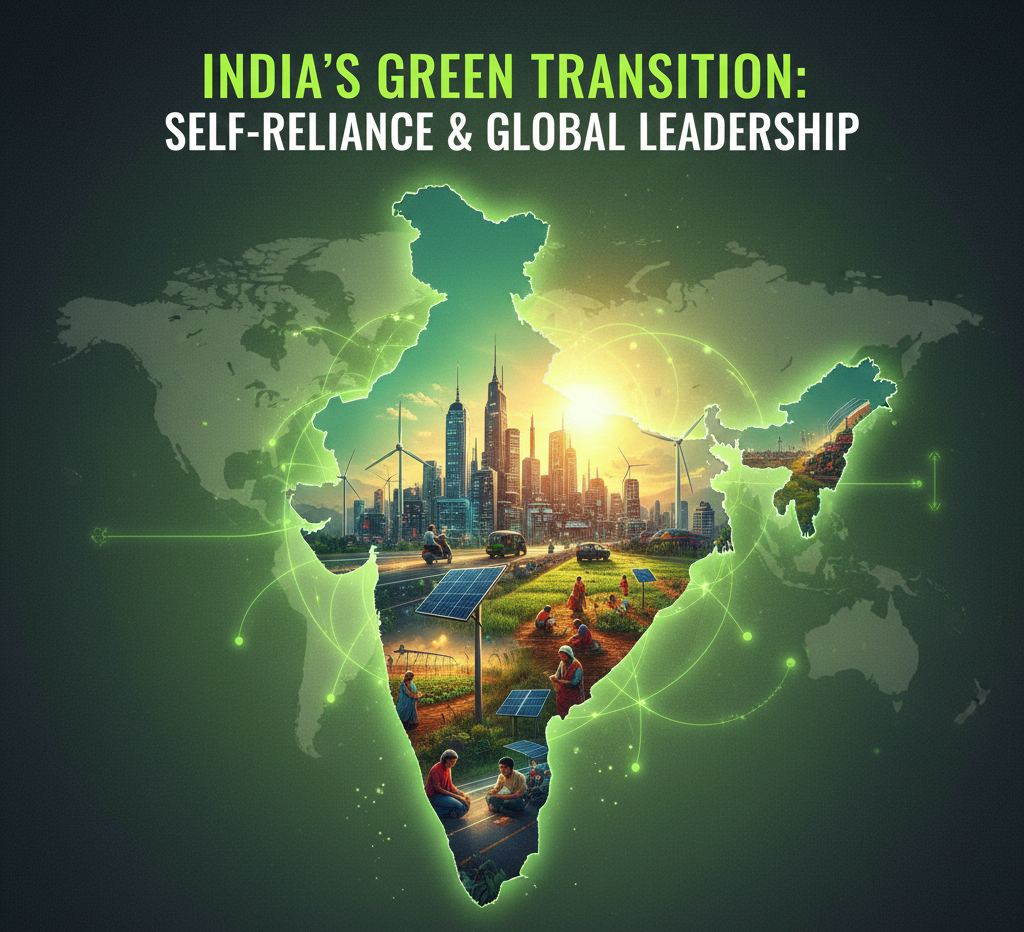
Self-Reliance in India’s Green Transition
Introduction
India stands at a pivotal moment in its developmental journey. As the world grapples with the escalating
threat of climate change, the nation must balance rapid economic growth with environmental
sustainability. In their article “For Green Transition, India Can Fall Back on Itself” (The Indian Express,
3 December 2025), Montek Singh Ahluwalia and Utkarsh Patel argue that India can achieve its net-zero
target by 2070 primarily through domestic reforms and self-financing, given the retreat of developed
nations from their climate finance commitments. This essay builds upon and critically examines that
premise. It contends that while India can indeed steer its own decarbonisation by mobilising domestic
resources, fostering innovation, and engaging with private and multilateral finance, success will depend
equally on overcoming deep-rooted political, social, and institutional challenges. True self-reliance
must therefore balance ambition with inclusion and resilience.
Economic Rationale
One of the strongest arguments for India’s green transition lies in its compatibility with economic
growth. Decarbonisation is not an obstacle to prosperity but a pathway towards it. Economic models
such as the REMIND-India framework suggest that India can sustain an annual growth rate of around
6.25 per cent while steering its emissions downward after 2035. This vision contrasts starkly with
traditional development models, where emissions peak much later and remain high for decades.
The underlying principle is simple yet powerful: cleaner energy and efficiency save money, create jobs,
and improve public health. Reducing dependence on fossil fuels not only curbs pollution but also lowers
healthcare costs associated with respiratory diseases and environmental degradation. The economic cost
of air pollution alone has been estimated at hundreds of billions of dollars annually, and a shift to
renewables could prevent this drain on national productivity. Moreover, the transition opens doors to
new industries—such as green hydrogen, electric mobility, and renewable manufacturing—that can
anchor India’s role in the global clean technology market.
The concept of “stranded assets” further strengthens the argument for transition. Investments in coal or
oil infrastructure risk becoming obsolete as the world moves toward renewables. Redirecting capital to
sustainable industries now can prevent massive future losses and attract investors seeking long-term,
stable returns.
Financing the Transition
The green transformation requires immense investment—estimated at over $2.5 trillion by 2070. With
the retreat of major economies from their climate finance obligations, India cannot depend on
concessional international aid. Instead, it must rely primarily on domestic resources and private sector
participation, supplemented by innovative multilateral mechanisms.
India’s electricity distribution companies, or discoms, lie at the heart of this financial puzzle. These
state-owned entities, burdened by losses exceeding ₹6 lakh crore, inhibit the viability of renewable
projects. Reforming them through improved governance, selective privatisation, and flexible pricing
mechanisms is essential. When discoms are financially stable, private investors gain confidence to fund
large-scale renewable projects.
Multilateral development banks (MDBs) must also evolve their role. Rather than relying solely on
grants or concessional loans, these institutions can use risk-sharing instruments, guarantees, and
blended finance to attract private capital. India, with its growing creditworthiness and proven record in
infrastructure execution, is well-positioned to benefit from such models.
However, this optimism should be tempered with realism. Access to finance is not just about supply—
it is about creating “bankable” projects. India must address regulatory uncertainties, delays in land
acquisition, and weak contract enforcement that often deter investors. Furthermore, reliance on
domestic borrowing and commercial international loans means the costs will be borne internally.
Without careful policy design, this could translate into higher energy prices or reduced public spending
elsewhere, disproportionately affecting low-income households. Hence, equity and fairness must
remain central to financial planning.
Political and Institutional Challenges
Economic models and financial mechanisms can illustrate what is technologically and economically
possible, but the true test lies in political feasibility. Implementing large-scale reforms in India’s federal
and democratic structure is notoriously difficult. The politics of energy pricing is one of the clearest
examples. Tariff reforms, while economically rational, face resistance from voter groups dependent on
subsidised electricity, especially farmers and low-income households. State governments, which control
most discoms, often prioritise short-term electoral gains over long-term sustainability.
This political economy dilemma has hindered reform for decades. Despite successful privatisation cases
in states like Gujarat and Odisha, most others have failed to replicate them due to entrenched interests
and lack of political consensus. Unless leaders are willing to take unpopular but necessary measures,
the structural inefficiencies that cripple the power sector will persist.
Administrative capacity also remains a concern. Large-scale infrastructure projects in renewables often
face bureaucratic bottlenecks—land disputes, slow clearances, and inconsistent taxation policies. The
absence of an efficient legal framework to resolve investor disputes quickly further undermines trust
and slows progress.
Moreover, climate transition requires coordination across multiple levels of government, from central
ministries to state and local agencies. This necessitates institutional reform, improved data systems, and
stronger accountability mechanisms—all of which take time and sustained effort.
Social Equity and Justice
A successful green transition must also be a just transition. The move towards renewable energy will
disrupt traditional industries and livelihoods. Millions employed in coal mining, thermal power, and
related sectors face displacement. These workers cannot simply be left behind; retraining programmes,
social safety nets, and targeted state support are crucial to prevent social unrest and economic exclusion.
Furthermore, energy access disparities remain stark. While urban centres consume vast amounts of
electricity, many rural households still lack reliable power. If renewable policies fail to address these
inequalities, they risk deepening the urban-rural divide. Equity should therefore guide the design of
subsidies, tariffs, and employment programmes to ensure that the benefits of transition are widely
shared.
The distributive dimension also extends to inter-state dynamics. Coal-dependent states such as
Jharkhand and Chhattisgarh derive a significant portion of their GDP from mining. Transition policies
must include fiscal transfers and localised investment strategies to diversify these regional economies.
Without such measures, economic dislocation could provoke political resistance that delays or reverses
progress.
Global Context and Strategic Autonomy
India’s commitment to achieve net zero by 2070 is not only an environmental pledge but also a strategic
opportunity. By taking early leadership in green manufacturing and technology, India can capture a
sizeable share of the global clean energy market, projected to reach trillions of dollars annually by 2030.
Investments in solar modules, battery storage, and electric vehicles under the Production Linked
Incentive (PLI) schemes demonstrate this ambition.
Yet, self-reliance should not translate into isolation. While India must prepare for a world with less
predictable international finance, it should continue to champion the principle of “common but
differentiated responsibilities.” The moral claim that industrialised nations owe a climate debt to
developing countries remains valid, regardless of temporary political shifts in the West. Strategic
partnerships, such as technology collaborations with the United States and Europe, remain essential for
access to advanced innovations and markets.
Over-reliance on domestic levers also risks vulnerability to geopolitical and economic shocks.
Diversifying partnerships, fostering South-South cooperation, and leveraging multilateral forums can
mitigate these risks. Ultimately, self-reliance should mean resilience and adaptability, not isolationism.
Conclusion
India’s path to a green future is both a necessity and an opportunity. The vision of achieving net zero
emissions by 2070 through self-reliance reflects a pragmatic understanding of global realities and
national capabilities. Economic growth and environmental responsibility are not mutually exclusive;
rather, they can reinforce one another when guided by smart policy and inclusive reform. Yet, the
journey demands more than technology and capital—it requires political will, social justice, and
institutional strength.
India’s self-reliant transition must therefore be grounded in fairness, foresight, and cooperation. Only
by integrating equity with ambition can the nation transform its green aspirations into lasting prosperity
and environmental stability. If done right, India’s model of self-reliant sustainability could illuminate a path for other developing nations—proving that independence and interdependence can coexist in the
global pursuit of a livable planet.
Subscribe to our Youtube Channel for more Valuable Content – TheStudyias
Download the App to Subscribe to our Courses – Thestudyias
The Source’s Authority and Ownership of the Article is Claimed By THE STUDY IAS BY MANIKANT SINGH