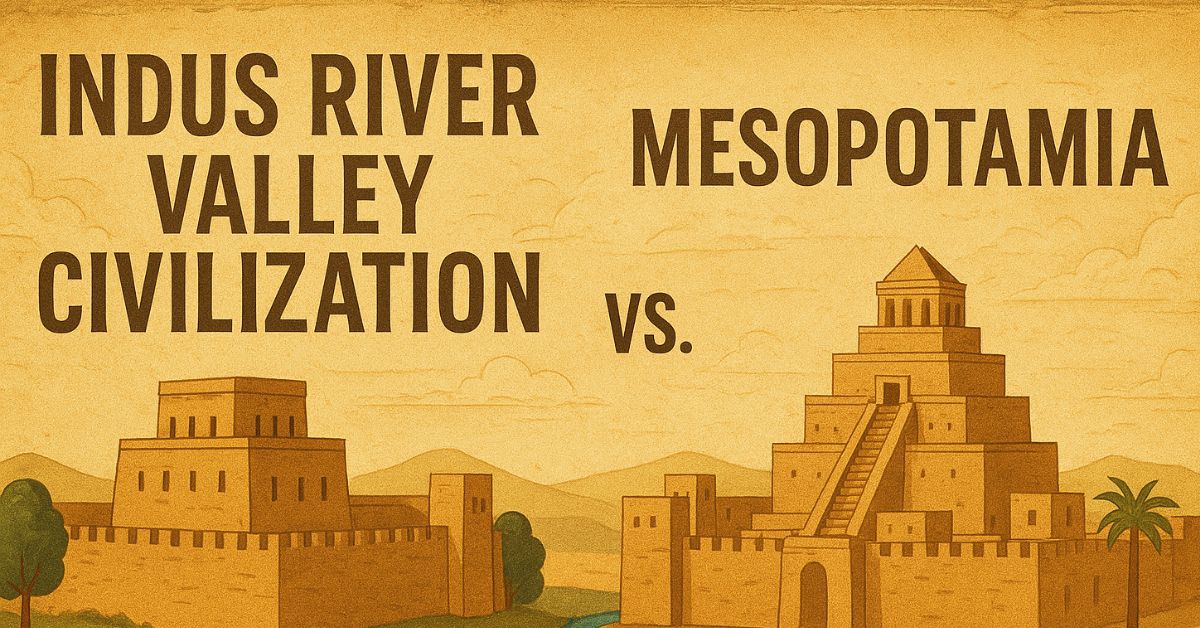
Indus Valley Civilization vs Mesopotamian Civilization (Comparative Study)
Indus Valley Civilisation vs Mesopotamian Civilisation: Comparative Study for UPSC
The ancient world witnessed the emergence of several great civilisations, among which the Indus Valley Civilisation (IVC) and the Mesopotamian Civilisation stand out as two of the earliest and most influential urban cultures. Both developed during the Bronze Age, flourished along fertile river valleys, and laid the foundations of organised urban life, trade networks, religious practices, and social institutions.
Despite these similarities, the two civilisations differed significantly in their political organisation, religious beliefs, urban planning, social structure, and lifestyle. A comparative study helps us understand diverse paths of early human development.
1. Time Period and Geographical Location
Indus Valley Civilisation (IVC)
The Indus Valley Civilisation, also called the Harappan Civilisation, was named after Harappa, the first site excavated in 1921. It flourished during the Bronze Age and was broadly contemporary with ancient Mesopotamia and Egypt.
Phases of the Harappan Civilisation:
- Early Harappan Phase – before 2600 BCE
- Mature Harappan Phase – c. 2600–1900 BCE
- Late Harappan Phase – after 1900 BCE
Geographically, it was one of the largest Bronze Age civilisations, extending:
- From Shortugai (Afghanistan) in the northwest
- To Daimabad (Maharashtra) in the south
- From Sutkagendor (Baluchistan) in the west
- To Alamgirpur (Uttar Pradesh) in the east
Most settlements were located along the Indus River and its tributaries, which provided fertile land and water for agriculture.
Mesopotamian Civilisation
The term Mesopotamia comes from Greek and means “the land between two rivers”, referring to the Tigris and Euphrates rivers. This region largely corresponds to present-day Iraq, with parts in Turkey and Syria.
Mesopotamian civilisation began much earlier, around 3500 BCE, with early urban centres such as Uruk and Ur. Over time, it witnessed successive civilisations:
- Sumerians
- Akkadians
- Babylonians
- Assyrians
Unlike the Harappan Civilisation, Mesopotamian civilisation continued for several millennia with continuous cultural evolution.
Comparison:
- Mesopotamia had a longer historical span
- The Indus Valley Civilisation reached its peak in the mid-third millennium BCE
2. Geographical Setting and Urban Planning
Indus Valley Civilisation
The IVC developed on the alluvial plains of the Indus river system and is best known for its advanced and uniform urban planning.
Key features:
- Cities like Harappa, Mohenjo-Daro, Dholavira, and Lothal
- Division into:
- Citadel (raised platform, possibly administrative/ritual)
- Lower town (residential area)
- Grid pattern streets intersecting at right angles
- Use of standardised baked bricks
- Well-developed drainage and sanitation system
- Almost every house had a bathroom connected to covered drains
This reflects a strong emphasis on public health and civic organisation.
Mesopotamian Civilisation
Mesopotamian cities also developed on fertile river plains but showed less uniform and more organic growth.
Key features:
- Prominent ziggurats (massive stepped temples) at city centres
- Cities like Ur, Uruk, Lagash, and Mari
- Ziggurats served religious, administrative, and economic purposes
- Urban planning evolved gradually rather than being centrally standardised
Comparison:
- IVC cities show planned uniformity and civic focus
- Mesopotamian cities emphasised religious and political authority
3. Trade and Economic Relations
Trade in the Indus Valley Civilisation
The Harappans were skilled traders with a well-organised system of internal and external trade.
Evidence includes:
- Standardised weights and measures
- Seals used for trade identification
- Transport via bullock carts and boats
Mesopotamian records refer to a land called Meluhha, identified with the Harappan region.
Exports:
- Carnelian beads
- Cotton textilesa
- Ivory
- Precious stones
- Handicrafts
Imports:
- Metals
- Timber
- Raw materials
Trade in Mesopotamian Civilisation
Mesopotamia lacked essential natural resources such as wood, stone, and metals, making long-distance trade crucial.
Key aspects:
- Extensive trade networks across West Asia
- Initially barter-based, later silver used as a standard of value
- Exported textiles, agricultural produce, and handicrafts
- Acted as a trade hub linking different regions, including the Indus Valley
4. Political Organisation and Governance
Indus Valley Civilisation
The political structure of the IVC remains a subject of debate.
Key observations:
- No clear evidence of kings, palaces, or royal tombs
- Uniformity in:
- Town planning
- Brick sizes
- Weights and measures
Possible forms of governance:
- Rule by merchants
- Rule by priests
- Collective or decentralised authority
Mesopotamian Civilisation
Mesopotamia had a clearly defined kingship.
Key features:
- Kings viewed as representatives of gods
- Responsible for:
- Law and order
- Irrigation
- Warfare
- Presence of written laws, notably the Code of Hammurabi
Strong centralised and hierarchical administration
5. Religion and Religious Practices
Religion in the Indus Valley Civilisation
Harappan religion is known mainly through archaeological remains.
Key features:
- Worship of a Mother Goddess
- Animal symbolism, especially bulls
- Seals depicting a yogic posture figure (Proto-Shiva/Pashupati)
- Fire altars at some sites
- Absence of large temples suggests domestic or community worship
Religion in Mesopotamian Civilisation
Religion played a central role in Mesopotamian life.
Key features:
- Polytheistic belief system
- Each city had a patron deity
- Gods associated with natural forces
- Ziggurats as centres of worship
- Natural calamities viewed as divine punishment
6. Society and Lifestyle
Economic and Social Life
Both civilisations were primarily agrarian and supported craft production.
Indus Valley:
- Crops: wheat, barley, pulses, cotton
- Society appears relatively egalitarian
- Limited evidence of sharp social divisions
Mesopotamia:
- Crops: wheat, barley, dates (irrigation-based)
- Clearly hierarchical society:
- Kings and priests
- Merchants and artisans
- Farmers
- Slaves
Women in Mesopotamia could own property and engage in trade, though society remained patriarchal.
7. Decline of the Civilisations
Indus Valley Civilisation
The decline after 1900 BCE was gradual.
Possible causes:
- Climate change
- Decline or shifting of river systems
- Reduced agricultural productivity
Mesopotamian Civilisation
Decline resulted from:
- Soil salinity due to over-irrigation
- Environmental degradation
- Continuous wars between city-states
- Foreign invasions
Despite decline, Mesopotamia left a lasting legacy in writing, law, and administration.
Conclusion
Both the Indus Valley and Mesopotamian Civilisations represent pioneering achievements in human history. While they shared similarities such as river-based agriculture, urban life, trade networks, and polytheistic beliefs, they followed distinct paths of development.
The Indus Valley Civilisation is renowned for its uniform town planning, sanitation, and civic organisation, whereas Mesopotamia is remembered for its kingship, writing system, legal traditions, and religious institutions. Together, these civilisations offer invaluable insights into the early evolution of human societies and the foundations of civilisation itself.
Trending FAQs: Indus Valley vs. Mesopotamian Civilisation
- Is the Indus Valley Civilisation older than Mesopotamia?
No. Mesopotamia predates the Indus Valley Civilisation. - What new evidence links IVC with Mesopotamia?
References to Meluhha in Mesopotamian texts and Harappan seals found in West Asia. - Why is IVC called an “urban but non-monarchical” civilisation?
Because no palaces, royal tombs, or clear kingship evidence exist. - Which civilization had better sanitation systems?
Indus Valley Civilisation. - What makes Mesopotamian cities religiously centralised?
Presence of ziggurats controlling economic and religious life. - Why is IVC considered more egalitarian?
Uniform housing and absence of elite monuments.
Subscribe to our Youtube Channel for more Valuable Content – TheStudyias
Download the App to Subscribe to our Courses – Thestudyias
The Source’s Authority and Ownership of the Article is Claimed By THE STUDY IAS BY MANIKANT SINGH