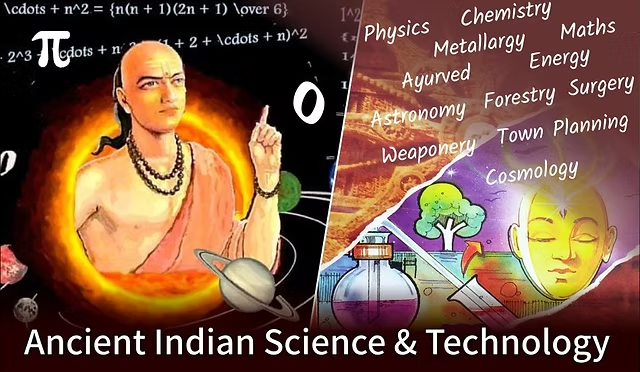
Ancient Indian Science & Technology
Ancient Indian Science & Technology
Introduction to Ancient Indian Scientific Tradition
When we talk about science, we often imagine laboratories, equations, and modern machines. But what if I told you that thousands of years ago, people in the Indian subcontinent were already thinking scientifically—observing nature, experimenting with materials, and developing technologies that still influence our lives today? Ancient Indian science and technology were not isolated achievements; they were deeply woven into everyday life, philosophy, and social needs.
Ancient India was one of the earliest centres of scientific inquiry in the world. From mathematics and astronomy to medicine and metallurgy, Indian thinkers laid foundations that later travelled to West Asia, Europe, and East Asia. Understanding these contributions is not just about glorifying the past; it’s about recognising India’s rightful place in the global history of science.
1. Science and Technology in the Harappan Civilisation
The Harappan or Indus Valley Civilisation (c. 3300–1900 BCE) represents one of the earliest examples of advanced urban culture. The scientific knowledge of the Harappans is evident from their town planning, architecture, craft production, and trade practices.
Urban Planning and Engineering
Harappan cities such as Harappa, Mohenjo-daro, Dholavira, and Lothal were carefully planned. Streets were laid out in a grid pattern, intersecting at right angles. Houses were built using standardised burnt bricks, indicating advanced knowledge of construction techniques. One of the most remarkable features was the efficient drainage system, with covered drains running along streets and connected to individual houses. This reflects an understanding of sanitation and public health.
Water Management
Almost every house had access to water through wells or channels. Structures like the Great Bath at Mohenjo-daro highlight the importance of water management and ritual bathing. The reservoirs at Dholavira show advanced hydraulic engineering suited to arid conditions.
Weights, Measures, and Trade
The Harappans used standardised weights and measures, mostly based on binary and decimal systems. This uniformity facilitated trade over long distances. Archaeological evidence suggests extensive trade networks with Mesopotamia and other regions.
Crafts and Metallurgy
Harappan artisans excelled in pottery, bead-making, shell-work, and metallurgy. Bronze tools and ornaments were produced using copper and tin. The famous bronze statue of the Dancing Girl demonstrates mastery over the lost-wax casting technique.
2. Metallurgy: Metal Science and Technology
Ancient India made outstanding contributions in the field of metallurgy, which continued to develop over several centuries.
Early Metal Use
The earliest evidence of copper use in the Indian subcontinent comes from sites like Mehrgarh. Over time, Indians developed techniques for smelting and alloying metals, leading to the use of bronze and later iron.
Iron Technology
India was among the earliest regions to develop iron technology. Iron tools and weapons became widespread during the later Vedic period. The quality of Indian iron was highly regarded.
Wootz Steel
One of the most significant metallurgical achievements was the production of wootz steel in southern India. This high-carbon steel was known for its strength, sharpness, and flexibility. It was exported to West Asia and Europe, where it became famous as Damascus steel.
Iron Pillar of Delhi
The Iron Pillar near Qutub Minar in Delhi, dating back to the Gupta period, is a remarkable example of corrosion-resistant iron. Despite being exposed to the elements for over a millennium, it has not rusted significantly. This reflects advanced knowledge of metal composition and treatment.
3. Mathematics: A Pioneering Legacy
Ancient India’s contributions to mathematics are among its most influential achievements, many of which form the basis of modern mathematical systems.
Sulbasutras and Geometry
The Sulbasutras, composed between 800–500 BCE, were manuals for constructing ritual altars. They contain detailed geometric principles, including rules for constructing squares, rectangles, and circles. The Sulbasutras present an early statement of what later came to be known as the Pythagorean theorem.
Decimal System and Zero
Perhaps the most revolutionary contribution of Indian mathematics was the development of the decimal place-value system and the concept of zero. This system made complex calculations easier and was later transmitted to the Arab world and Europe, shaping global mathematics.
Aryabhata
Aryabhata, one of the greatest Indian mathematicians, authored the Aryabhatiya in the 5th century CE. He explained methods for solving arithmetic and algebraic problems and made important contributions to trigonometry by introducing sine functions. Aryabhata also proposed that the Earth rotates on its axis, a remarkable scientific insight for his time.
Brahmagupta
Brahmagupta, a 7th-century mathematician, formally defined zero and explained arithmetic operations involving zero and negative numbers. His work marked a major step forward in algebra and number theory.
Bhaskara
Bhaskara I and Bhaskara II further developed Indian mathematics. Bhaskara II’s work on algebra and calculus-like concepts demonstrates the advanced level of mathematical thinking in ancient India.
4. Logical and Philosophical Foundations of Science
Scientific inquiry in ancient India was closely connected with philosophy. Several philosophical schools contributed to logical reasoning and systematic thought.
Nyaya and Vaisheshika Schools
The Nyaya school developed a structured system of logic and epistemology. It identified valid sources of knowledge such as perception, inference, comparison, and testimony. These ideas form the basis of rational and scientific thinking.
The Vaisheshika school proposed an early form of atomism, suggesting that all material objects are composed of indivisible atoms. It also classified reality into categories such as substance, quality, action, and relation.
Samkhya Philosophy
The Samkhya school offered a rational explanation of the universe based on the interaction between Purusha (consciousness) and Prakriti (matter). Its systematic classification of natural elements influenced later scientific and medical thought.
5. Medicine and Health Sciences
Ancient India developed sophisticated systems of medicine that emphasised both treatment and prevention.
Ayurveda
Ayurveda, meaning the “science of life,” is one of the oldest medical systems in the world. It is based on the balance of three bodily humours, Vata, Pitta, and Kapha, and the five elements. Ayurvedic texts describe anatomy, physiology, diagnosis, and treatment in detail.
The Charaka Samhita focuses on internal medicine and emphasises diet, lifestyle, and ethics in medical practice.
Sushruta and Surgery
Sushruta, regarded as the father of surgery, authored the Sushruta Samhita. This text describes over 300 surgical procedures and 120 surgical instruments. Techniques such as plastic surgery, cataract surgery, and fracture management were well developed. Sushruta also stressed cleanliness and post-operative care.
Siddha System
The Siddha system of medicine, mainly practised in southern India, used herbal and mineral preparations. It emphasised longevity, preventive healthcare, and the harmonious functioning of the body.
Yoga
Yoga, systematised by Patanjali, contributed to physical and mental health. Practices such as postures, breathing techniques, and meditation reflect an understanding of human physiology and psychology.
Veterinary Science
Ancient India also developed veterinary medicine, particularly during the Mauryan period. Hospitals for animals and texts on animal care indicate advanced knowledge in this field.
6. Astronomy and Space Science
Astronomy occupied an important place in ancient Indian science due to its connection with agriculture, navigation, and religious rituals.
Vedanga Jyotisha
The Vedanga Jyotisha, one of the earliest astronomical texts, dealt with the calculation of time, lunar phases, and solar movements. It helped in fixing dates for rituals and agricultural activities.
Aryabhata and Astronomy
Aryabhata provided accurate explanations of solar and lunar eclipses and rejected mythological interpretations. He calculated the length of the solar year with remarkable precision.
Varahamihira
Varahamihira, a renowned astronomer, compiled earlier astronomical knowledge in works such as Brihat Samhita. He also discussed planetary motion and hinted at the concept of gravitational attraction.
Jantar Mantar
During the early modern period, large astronomical observatories known as Jantar Mantar were built. These structures were used to measure time, track celestial movements, and predict eclipses, reflecting the continuity of India’s astronomical tradition.
7. Other Technological Innovations
Shipbuilding and Navigation
Ancient Indian texts and archaeological evidence indicate the construction of large ships for maritime trade. Indian merchants traded with Southeast Asia, West Asia, and Africa, demonstrating knowledge of navigation and ship design.
Textiles and Dyeing
India was famous for its cotton textiles and dyeing techniques. Natural dyes such as indigo were produced using advanced chemical knowledge. Indian textiles were highly valued in foreign markets.
Agricultural Technology
Ancient Indians developed irrigation techniques, crop rotation practices, and tools adapted to different ecological regions. Agricultural science was closely linked with astronomy and meteorology.
8. Strengths, Limitations, and Legacy
Strengths
- Emphasis on observation, logic, and systematic classification
- Integration of science with philosophy and daily life
- Significant contributions to mathematics, medicine, metallurgy, and astronomy
Limitations
- Restricted access to education due to social stratification
- Limited participation of women in formal scientific learning
- Decline of urban centres and patronage in later periods
Legacy
Despite these limitations, ancient Indian science left a lasting impact on global knowledge systems. Concepts such as zero, decimal notation, surgical techniques, and astronomical calculations continue to influence modern science.
Conclusion
Ancient Indian science and technology represent a rich and diverse intellectual tradition rooted in rational inquiry and practical application. From the planned cities of the Harappans to the mathematical genius of Aryabhata and the medical expertise of Sushruta, India made pioneering contributions to human civilisation. These achievements highlight the scientific temper of ancient Indian society and its enduring legacy.
FAQs: Ancient Indian Science & Technology
- What were the main scientific achievements of the Harappan civilisation?
The Harappans excelled in urban planning, drainage systems, water management, standardised weights and measures, and advanced craftsmanship, including metallurgy and bead-making. Their cities like Mohenjo-daro and Dholavira reflect remarkable engineering skills. - What is wootz steel, and why is it important?
Wootz steel, produced in southern India, was a high-carbon, corrosion-resistant steel known for its strength and flexibility. It was exported worldwide and influenced the famous Damascus steel, showcasing India’s advanced metallurgical knowledge. - How did ancient India contribute to mathematics?
Ancient India developed the decimal system, the concept of zero, and trigonometry. Mathematicians like Aryabhata, Brahmagupta, and Bhaskara made pioneering contributions that laid the foundation for modern arithmetic, algebra, and geometry. - What were the key contributions of Ayurveda and Sushruta to medicine?
Ayurveda emphasised holistic health, balance of bodily humours, and preventive care, while Sushruta pioneered surgical techniques, including plastic surgery, cataract surgery, and fracture management, demonstrating advanced medical knowledge. - How advanced was astronomy in ancient India?
Astronomers like Aryabhata and Varahamihira accurately calculated eclipses, solar and lunar movements, and the solar year. Observatories like Jantar Mantar highlight the continuity of India’s precise observational astronomy.
Subscribe to our Youtube Channel for more Valuable Content – TheStudyias
Download the App to Subscribe to our Courses – Thestudyias
The Source’s Authority and Ownership of the Article is Claimed By THE STUDY IAS BY MANIKANT SINGH