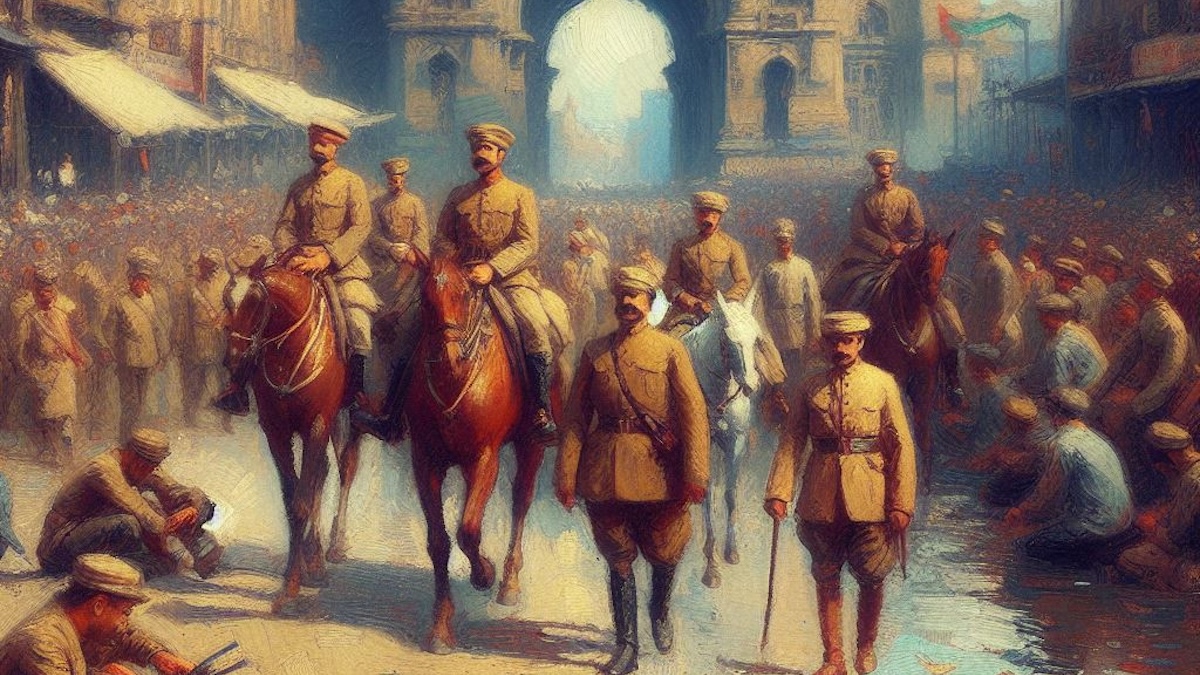
British Expansion in India: A Chronological Narrative
British Expansion in India: A Chronological Narrative
The history of British expansion in India is one of the most transformative periods in the subcontinent’s past. It marks the shift from European trade interests in spices and textiles to the establishment of a vast colonial empire that reshaped India’s political, economic, and social life for nearly three centuries. This narrative begins with the arrival of the British East India Company (EIC) and culminates in the end of colonial rule in 1947. Throughout this period, the British expanded their influence and control through diplomacy, warfare, treaties, and administrative innovations as they gradually moved from trade to sovereign power.
1. The Advent of the British East India Company (1600–1757): British Expansion in India
1600: Formation of the Company
In 1600, Queen Elizabeth I of England granted a royal charter to a group of London merchants forming the Governor and Company of Merchants of London Trading to the East Indies, commonly known as the British East India Company (EIC). The charter gave the Company a monopoly on English trade with the East Indies and laid the foundation for its future activities in India.
Early Voyages and Trading Posts
Soon after its establishment, the Company launched voyages to the Indian Ocean. In 1601, the first voyage led by Sir James Lancaster sailed aboard the Red Dragon to India. Although early attempts to establish a trading post at Surat were initially blocked, the Company persisted. By 1611, the first factory (trading post) was established at Masulipatnam, and by 1613, the Company secured permission from Mughal Emperor Jahangir to build a permanent factory in Surat—its first enduring foothold on Indian soil.
The EIC soon established additional trading posts along the Indian coast, including Madras, Bombay, and Calcutta, creating a network of commercial bases for trade in textiles, spices, and other goods.
Early British Presence and European Rivalry
Throughout the early seventeenth and early eighteenth centuries, European powers, Portuguese, Dutch, French, and British competed for control of Indian trade. During this time, the British East India Company remained primarily a trading enterprise but gradually increased its military presence to protect its commercial interests.
2. From Traders to Territorial Power: The Mid-18th Century (1757–1765)
1757: The Battle of Plassey
A major turning point in British expansion came in 1757 with the Battle of Plassey. Under the leadership of Robert Clive, Company forces defeated the army of the Nawab of Bengal, Siraj-ud-Daulah, through a combination of military strategy and political intrigue, including the betrayal by key Indian allies.
This victory turned the Company from a commercial entity into a political power in India, enabling it to dominate Bengal—a rich and strategically important province—and setting the stage for expanded territorial control.
1764: The Battle of Buxar and Diwani Rights
The Battle of Buxar in 1764 further consolidated British power. The combined forces of Indian rulers including the Mughal Emperor Shah Alam II, the Nawab of Awadh, and the deposed Nawab of Bengal—were defeated by the Company’s army. The outcome was significant, as the subsequent Treaty of Allahabad (1765) granted the EIC the Diwani rights, or the authority to collect revenue in Bengal, Bihar, and Orissa.
With control of revenue, the Company’s influence expanded far beyond trade into administration and governance, making it the chief political authority in eastern India.
3. Consolidation of Power and Expansion (1765–1857): British expansion in India
Regulating Acts and Administrative Control
As the Company’s territorial holdings in India grew, the British Parliament became increasingly concerned about mismanagement and abuses. The Regulating Act of 1773 was passed to bring the Company under state supervision, creating the office of Governor-General to oversee the administration of British territories in India. Warren Hastings became the first Governor-General under this system.
Further control was established through the Pitt’s India Act of 1784, which strengthened parliamentary oversight of the Company’s affairs, setting up a Board of Control in Britain.
Wars and Expansion Across India
During this period, the British engaged in a series of wars that expanded their territorial control:
- Anglo-Mysore Wars (1767–1799): These conflicts ended with the defeat of Tipu Sultan in 1799, bringing most of Mysore under British influence.
- Anglo-Maratha Wars (1772–1818): Three wars against the powerful Maratha Confederacy culminated in British victory and significant territorial gains in central and western India.
- Anglo-Sikh Wars (1845–1849): Battles against the Sikh Empire in Punjab resulted in the annexation of Punjab into British India.
Expansion Through Diplomatic Policies
Two key political methods helped the British expand their control without direct military conquest:
- Subsidiary Alliance (late 18th–early 19th century): Introduced by Lord Wellesley, this system forced Indian rulers to accept British troops in their states and surrender their own armies, effectively making them subordinate allies.
- Doctrine of Lapse (mid-19th century): Instituted during the tenure of Lord Dalhousie, this policy allowed the British to annex any princely state where the ruler died without a biological heir, dismissing traditional succession practices. It resulted in the annexation of several states, strengthening British power.
Economic and Social Changes
During this era, the British introduced significant economic and administrative changes. Land revenue systems like the Permanent Settlement (1793) in Bengal altered agricultural relations, often to the disadvantage of Indian peasants. British policies favored the export of raw materials and the import of British manufactured goods, altering India’s economic structure.
The British also introduced infrastructure such as railways, telegraphs, and canals primarily to serve imperial interests but these had lasting impacts on India’s economic landscape.
4. The Revolt of 1857 and the End of Company Rule
1857: First War of Independence
The year 1857 marked a critical moment in Indian history with the outbreak of the Indian Rebellion—also called the Sepoy Mutiny—a widespread uprising against the East India Company’s rule. It was fueled by military grievances, economic hardship, and widespread resentment of British policies. Although ultimately suppressed, it shook the foundations of British dominance.
1858: British Crown Takes Over
In the aftermath of the rebellion, the British Parliament passed the Government of India Act 1858, transferring power from the East India Company to the British Crown. This marked the official beginning of the British Raj, a period of direct imperial rule under the British monarch. Queen Victoria was later proclaimed Empress of India in 1876.
5. British Raj: Consolidation, Reforms, and Nationalism (1858–1947)
Under the British Crown, the empire in India expanded further, incorporating territories such as Upper Burma (1886) and administering large areas directly, while numerous princely states continued under indirect control.
Administrative and Legal Reforms
The British introduced reforms aimed at strengthening their administrative control, including changes in the judiciary, police, and revenue systems. They also passed laws like the Vernacular Press Act (1878) to regulate Indian language newspapers and the Factory Act (1881) to regulate labor.
Birth of Indian Nationalism
Alongside imperial governance, Indian resistance evolved into organized political movements. The Indian National Congress was founded in 1885, providing a platform for public debate and the demand for greater self-rule.
As the twentieth century progressed, major independence movements emerged, including Non-Cooperation (1920), Civil Disobedience (1930), and Quit India (1942), led by figures like Mahatma Gandhi and others, challenging British authority.
Impact of World Wars
World Wars I and II weakened Britain’s economic and military capacity, further strengthening India’s demands for independence. An intensified nationalist struggle, combined with political negotiations, ultimately led to Britain’s decision to leave India.
6. Indian Independence and the End of British Rule (1947)
After decades of sustained struggle, India achieved independence from British rule on 15 August 1947. The subcontinent was partitioned into two sovereign dominions: India and Pakistan, bringing an end to nearly 350 years of British presence in India, from initial trade beginnings to full colonial rule and eventual freedom.
Chronology of Major Events
The expansion of British influence in India began in 1600 with the founding of the East India Company under a Royal Charter, eventually leading to their first factory at Masulipatnam in 1611 and factory rights in Surat by 1613. The transition from trade to political dominance was marked by the Battle of Plassey in 1757 and the Battle of Buxar in 1764, which granted the Company Diwani rights. Administrative control was formalized through the Regulating Act of 1773, and territorial expansion continued as the British defeated Tipu Sultan in 1799, subdued the Marathas by 1818, and annexed Punjab in 1849. Following the Indian Rebellion of 1857, the British Crown assumed direct control in 1858, later proclaiming Queen Victoria as Empress of India in 1876. The rise of organized resistance led to the founding of the Indian National Congress in 1885, a movement that culminated in 1947 when India finally gained independence, marking the end of British rule.
7. Conclusion ( British expansion in India )
The British expansion in India did not occur overnight. It was a gradual process that unfolded over centuries, beginning with trade and ending with colonial domination and ultimately Indian independence. From humble beginnings as a trading enterprise, the British East India Company transformed itself into a dominant territorial power by exploiting political divisions, winning decisive battles, and implementing strategic administrative policies. Under the British Crown, India was reshaped economically, socially, and politically, leaving a legacy that continues to influence the subcontinent’s history. The story of British expansion is thus central to understanding India’s modern history and its struggles for sovereignty and self-rule.
Subscribe to our Youtube Channel for more Valuable Content – TheStudyias
Download the App to Subscribe to our Courses – Thestudyias
The Source’s Authority and Ownership of the Article is Claimed By THE STUDY IAS BY MANIKANT SINGH