Dark Enlightenment And Accelerationism : The Technocratic Threat
21 Aug 2026
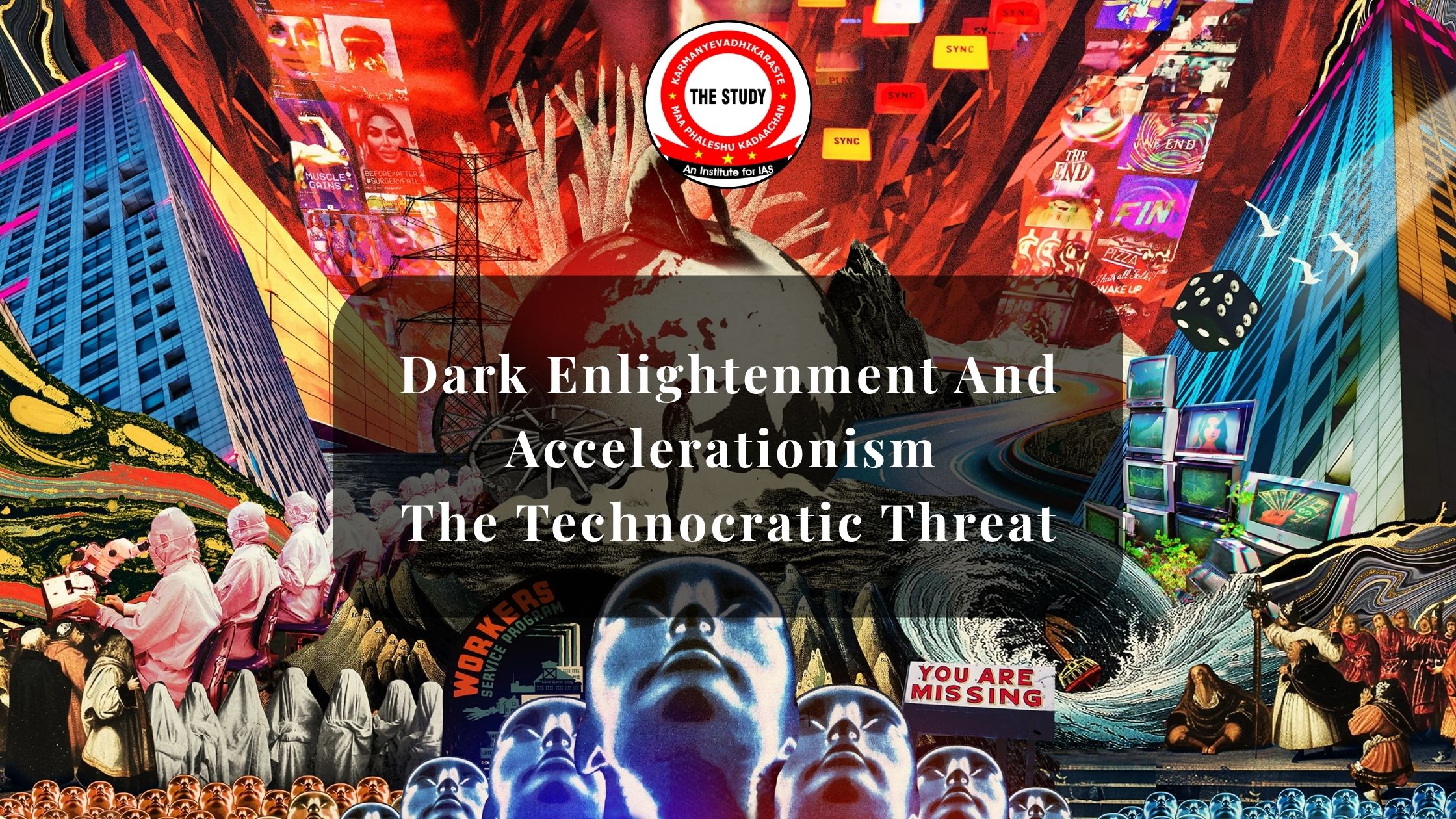
Dark Enlightenment and Accelerationism: The Technocratic Threat
Introduction
The Dark Enlightenment and accelerationism are contemporary political-philosophical ideas that have gained attention in debates surrounding technology, artificial intelligence, capitalism, democracy, and the future of governance. The topic is particularly relevant to students of Political Science, Sociology, Ethics, Governance and International Relations, because it raises a fundamental question: Can technological efficiency and private expertise become so powerful that they begin to challenge democratic accountability?
The term Dark Enlightenment is primarily associated with British philosopher Nick Land, whose 2012 essay of the same name became an important text in the modern neo-reactionary (NRx) intellectual movement. American computer programmer and blogger Curtis Yarvin, writing as Mencius Moldbug, had earlier developed related arguments questioning liberal democracy and proposing alternative forms of governance.
However, an important distinction is necessary: accelerationism is a broader intellectual current and should not be treated as synonymous with the Dark Enlightenment. Different accelerationist traditions have very different political objectives. The right-wing variant associated with Land connects technological and capitalist acceleration with a rejection of democratic and egalitarian political arrangements.
The subject is therefore best understood not as a mainstream political doctrine, but as a fringe and controversial intellectual current whose ideas provide a useful lens for examining technology, concentrated power, democracy and governance.
Understanding Dark Enlightenment, Accelerationism and the Technocratic Challenge
What is the Dark Enlightenment?
The Dark Enlightenment is a neo-reactionary political philosophy that questions the assumptions underlying modern liberal democracy, particularly political equality, universalism and democratic participation.
Nick Land's formulation emerged from his earlier engagement with capitalism, cybernetics, technology and post-humanism. Later, his political writings moved towards explicitly anti-democratic and anti-egalitarian positions. The Australian National University describes the contemporary movement associated with Land as rejecting democracy and embracing more authoritarian forms of rule.
At its core, the argument is that democratic governments may be too slow, constrained by elections and public opinion, to respond effectively to technological and economic change.
This makes the idea particularly relevant to contemporary debates over AI governance, platform power and technology-driven decision-making.
How is Accelerationism different from the Dark Enlightenment?
Accelerationism is a broader family of ideas arguing that existing technological, economic or social processes can be intensified to produce fundamental transformation.
Its intellectual origins are complex. Early accelerationist thinking emerged partly from the work of Gilles Deleuze and Félix Guattari, while Nick Land later developed a distinctly technological and capitalist interpretation during his work with the Cybernetic Culture Research Unit (CCRU) at the University of Warwick.
There are both left- and right-oriented versions of accelerationism.
The Dark Enlightenment is associated particularly with right-wing accelerationism, in which technological and capitalist acceleration is connected with the rejection of democratic egalitarianism. Therefore:
Accelerationism = broader intellectual family
Dark Enlightenment = specific neo-reactionary current associated with Nick Land
This distinction is important for competitive examinations.
Who are the major thinkers associated with the movement?
Two names are particularly important:
Nick Land – British philosopher associated with accelerationism and the Dark Enlightenment.
Curtis Yarvin (Mencius Moldbug) – American computer programmer and blogger whose writings criticised liberal democracy and proposed alternative models of political organisation.
Land's The Dark Enlightenment and Yarvin's earlier writings form important intellectual reference points for understanding the neo-reactionary movement.
Land's intellectual journey is especially significant because his earlier work at Warwick's CCRU explored cybernetics, technology, capitalism and post-humanism before his later political writings moved towards neo-reactionary thought.
Why is technology central to Dark Enlightenment thinking?
Technology is not viewed merely as a collection of tools in this intellectual tradition. It is treated as a force capable of transforming institutions and social relations.
Land's accelerationist thinking gives technological and capitalist processes a degree of autonomy from conventional political control. The argument is that technological development can move faster than traditional political institutions.
This produces a crucial contemporary governance question:
If technology develops faster than democratic institutions can regulate it, who ultimately controls society—the elected state or technological systems and their owners?
This question has become increasingly relevant with artificial intelligence, algorithmic decision-making, digital platforms, biotechnology and data-driven governance.
Why is the idea called a “technocratic threat”?
The phrase “technocratic threat” should be understood as an analytical concern, not as an established fact that Dark Enlightenment has replaced democratic government.
The concern arises when technical expertise becomes concentrated in a small group of corporations, engineers, investors or technology owners and is treated as sufficient justification for political decision-making.
The central danger can be represented as:
Technological power → Economic concentration → Control over information → Institutional influence → Reduced democratic accountability
Critics therefore argue that efficiency cannot substitute for constitutionalism, transparency, equality, rights and democratic accountability.
Recent scholarship has also examined how computational systems and corporate power can become mechanisms of authority when corporations increasingly perform functions traditionally associated with public institutions.
What are the major criticisms of Dark Enlightenment?
The movement has attracted extensive criticism because of its rejection of democratic equality and its hierarchical conception of political authority.
Critics identify several concerns:
- Democratic deficit: Political authority becomes concentrated rather than publicly accountable.
- Erosion of equality: Equal citizenship can be replaced by hierarchical social arrangements.
- Concentration of economic power: Private ownership may translate into political power.
- Technological determinism: Technology may be treated as an autonomous force rather than something shaped by social choices.
- Human-rights concerns: Reduced democratic participation can weaken mechanisms protecting minorities and individual rights.
- Elite capture: Highly specialised technical knowledge may increase the influence of a small technological elite.
Academic discussions have consequently connected neo-reactionary thought with anti-democratic and anti-egalitarian politics, although interpretations of its precise relationship with fascism and the wider political right remain contested.
Why is Dark Enlightenment relevant to UPPSC and other competitive exams?
For UPPSC, UPSC and other competitive examinations, the topic is useful primarily as a contemporary political thought and governance concept, rather than as a conventional static-history topic.
It can be connected with:
- Democracy and constitutionalism
- Artificial Intelligence and governance
- Digital sovereignty
- Platform capitalism
- Data governance
- Technocracy
- Political accountability
- Ethics of technology
- Inequality and concentration of wealth
- Future of the state
For Mains, a good answer should not endorse or dismiss the theory without analysis. Instead, examine both the claimed advantages of technological efficiency and the democratic risks of concentrated technological power.
The Dark Enlightenment should not be confused with the broader Enlightenment of the eighteenth century.
What are the Previous Year Exam-Oriented Points?
There is an important authenticity caveat for aspirants: Dark Enlightenment is a niche contemporary political-philosophy concept, and it should not be presented as a frequently repeated UPSC/UPPSC PYQ theme without verified evidence.
For examination purposes, remember these conceptual linkages:
- Nick Land → Dark Enlightenment and accelerationism
- Curtis Yarvin → Mencius Moldbug → neo-reactionary thought
- Accelerationism is broader than Dark Enlightenment.
- Right-wing accelerationism is associated with technological and capitalist intensification.
- The debate raises questions about democratic accountability versus technological efficiency.
- Technocracy does not automatically mean authoritarianism; the key issue is the relationship between expertise and democratic accountability.
- AI and algorithmic governance make the debate increasingly relevant.
What is the Final Verdict on Dark Enlightenment and Accelerationism?
The real importance of the Dark Enlightenment lies less in its present institutional influence and more in the questions it forces democratic societies to confront.
Technology can improve public administration, reduce transaction costs and make governance more efficient. But technological capability does not automatically provide legitimacy, justice or accountability.
For India, the appropriate response is therefore neither technological rejection nor blind technological optimism. Constitutional democracy must seek a balance in which innovation is encouraged while fundamental rights, transparency, parliamentary oversight, judicial review and democratic accountability remain protected.
This provides an excellent framework for GS-II, Essay and Ethics answers: technology should strengthen the capacity of the state without becoming a substitute for democratic constitutionalism.
FAQs
1. What is the Dark Enlightenment?
It is a neo-reactionary political current associated particularly with Nick Land that challenges modern democratic and egalitarian political arrangements.
2. Who coined or popularised the term Dark Enlightenment?
The term is principally associated with philosopher Nick Land, particularly through his 2012 essay The Dark Enlightenment.
3. Who is Curtis Yarvin?
Curtis Yarvin, who wrote under the name Mencius Moldbug, is an important figure in neo-reactionary political thought.
4. Is accelerationism the same as Dark Enlightenment?
No. Accelerationism is a broader intellectual category. Dark Enlightenment represents one particular neo-reactionary/right-accelerationist development.
5. Why is the topic relevant to UPSC and UPPSC?
It connects contemporary technology with democracy, governance, ethics, inequality, AI and constitutional accountability, making it useful for analytical answers.
6. Is Dark Enlightenment a mainstream political ideology?
No. It remains a fringe and controversial intellectual current, although scholars and commentators study it because of its relationship to contemporary debates about technology and political power.
Subscribe to our Youtube Channel for more Valuable Content – TheStudyias
Download the App to Subscribe to our Courses – Thestudyias
The Source’s Authority and Ownership of the Article is Claimed By THE STUDY IAS BY MANIKANT SINGH