How to Study History Optional for UPSC
18 Apr 2026
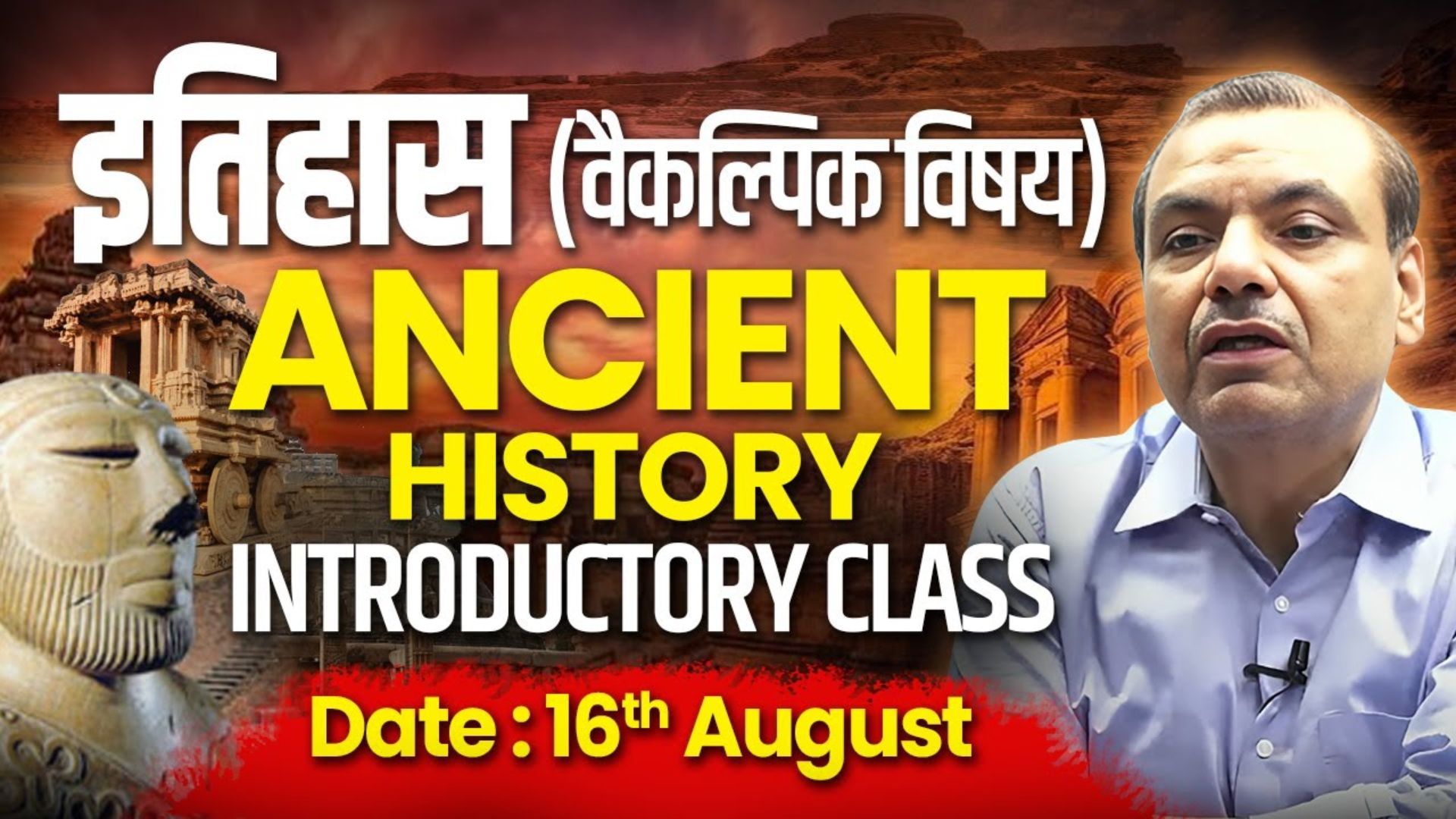
How to Study History Optional for UPSC: The Framework That Gets You 300+
By Manikant Singh, Founder, The Study IAS | 33+ years of UPSC History Optional teaching
The single most important thing to understand about History Optional is this: history is not the study of events, it is the study of changes. The moment you internalise that distinction, every topic, every question, every answer clicks into place. Without it, you will keep reading and forgetting, because disconnected information has nowhere to stick.
Watch Manikant Sir explain the "History as a Study of Changes" concept in this live session.
Why History Optional Requires No Background Knowledge; But Does Require the Right Mindset
History is the one optional subject that demands no prior specialisation. You do not need to have studied it at the undergraduate level. You do not need a humanities background. What you do need is the willingness to think analytically rather than reproduce information.
Compare this with other popular optionals. Literature demands a particular sensibility, an instinctive engagement with language beyond utility. Most aspirants lack this, and no amount of preparation can fully manufacture it. Political Science and Sociology papers with thinkers and thought (chintak aur vichar) require you to understand intellectual traditions in abstraction and when taught without contextualising the economic and social conditions that produced each thinker, these subjects become genuinely boring and genuinely hard to retain.
How to build the right mindset for History.
History Optional avoids this trap entirely. Paper I has no thinkers-and-thought section. The closest equivalent challenge is the map question, 20 locations to identify and that challenge, approached correctly, becomes a structural advantage rather than a burden.
The Map Question: Convert a Liability into a Guaranteed Score
Most candidates treat map preparation as an afterthought, two intensive days before the exam. This is precisely wrong.
The map question in Paper I (Ancient History section) is 20 marks with no partial exemptions. You get 20 locations plotted on a map and must identify each with a 30-word description. Every blank is a loss.
The right approach is to integrate map work into content preparation from day one. Here is why this works: maps are never geographically isolated facts. Every location has multiple dimensions.
Take Ujjain as an example. Ujjain is simultaneously:
- A provincial capital (prashashnik kendra) under the Mauryas
- A capital under the Shaka rulers
- Associated with the Gupta period
- One of the sixteen Mahajanapadas (Avanti's capital)
- An industrial centre with bead factories (manka ka karkhana) in ancient times
- A cultural and religious centre- home to the Mahakal temple, one of the twelve Jyotirlingas
When UPSC plots Ujjain on the map, they can ask about it as a political capital in one year, as a temple site the next year, or as an economic centre the year after that. A student who has studied Ujjain only as a location to mark will be caught off-guard by unexpected framing. A student who learned Ujjain as part of Mauryan administration, Shaka history, and Gupta cultural geography will handle any framing confidently.
Watch full video for Integrated Map Mapping Strategy
This is the integrated approach: when you study Mauryan provincial administration, mark Ujjain on your map. When you study trade routes, mark it again under economic centres. When you study temple architecture, mark it under religious sites. By the time the exam arrives, your map knowledge is embedded in your content knowledge, not a separate memorisation exercise.
The Central Framework: Four Pillars of Historical Study
Every topic in History Optional, ancient, medieval, or modern should be approached through the same analytical framework. Commit this to memory before you read a single page of content.
1. Changes (parivartan ki samajh) - the core of everything
2. Sources of Study (adhyayan ke srot) - what evidence we are working with
3. Historiography (itihas lekhan) - how historians have interpreted the evidence
4. Periodisation (kal vibhajan ki samajh) - why we divide history the way we do
Of these four, changes are primary. Master the changes framework and the other three fall into place naturally, because you will automatically ask: what evidence tells us this change occurred? How have historians interpreted it? Which period does it belong to?
Watch the Four Pillars in action : Click here to watch full video
How to Track Changes: The Two-Formula System
The changes you track depend on what kind of evidence is available for that period. This is not a minor technical point, it fundamentally changes how you read and organise material.
Decoding Formula 1 & 2 for UPSC
Formula 1: Pre-History and Proto-History (Prehistoric and Early Historic Periods)
From the Palaeolithic period (approximately 500,000 BCE) through the Harappan civilisation and up to the Vedic age, written sources are either absent or undeciphered. The Harappan script remains unread. For this vast stretch, which constitutes approximately 99.8% of the total span of human history, we depend entirely on archaeological evidence: habitation sites, pottery, tools, skeletal remains, cave paintings, beads, and other material culture.
For these periods, track changes across five dimensions:
- Climatic factors (jalvayu sambandhi karak) — which geological epoch, what environmental conditions
- Technological change (takniki parivartan) — stone tool types, metallurgy, construction methods
- Subsistence change (jivika paarjan mein parivartan) — from hunting-gathering to pastoralism to settled agriculture
- Social relations (samajik sambandh) — band society to clan society to settled communities
- Cultural change (sanskritik parivartan) — burial practices, artistic expression, religious impulse
Apply this formula to each sub-period: Palaeolithic, Mesolithic, Neolithic, Chalcolithic, Harappan, Post-Harappan. Track each dimension forward. The continuities and discontinuities between periods become your analytical insight.
Formula 2: Historical Period (Vedic Age to Early Medieval)
From the Vedic period (approximately 1500 BCE) through to the Early Medieval period (around 1200 CE), we have all three types of evidence simultaneously: archaeological sources, literary sources, and foreign accounts. This dramatically increases both the richness and the interpretive complexity of the material.
For these periods, track changes across four dimensions:
Political changes (rajnitik parivartan)
- Political expansion: states, empires, dynasties, rulers
- Administrative structure: how the state was organised
Economic changes (arthik parivartan)
- Agriculture: crop patterns, irrigation, land tenure
- Craft and industry: guild systems, specialised production
- Trade: internal and external, coinage, urbanisation
- Pastoralism: important in early periods, fades later
Social changes (samajik parivartan)
- Varna and jati: caste hierarchy and its evolution
- Social relations: family structure, kinship
- Status of women: changes across periods
- Status of Shudras and untouchables
Cultural changes (sanskritik parivartan)
- Religion and philosophy: this is where the most dramatic changes occur
- Language and literature
- Science and technology
- Art and architecture (becomes significant from the Mauryan period onwards)
Vertical and Horizontal Reading: The Double-Axis Method
Once you have this framework in place, your preparation has two movements.
Vertical reading means going through all four dimensions (political, economic, social, cultural) for each period chronologically. Vedic age: cover all four dimensions. Buddhist period: cover all four dimensions. Mauryan, post-Mauryan, Gupta, post-Gupta, Early Medieval, each one complete.
Horizontal reading means cutting across all periods to study the evolution of one dimension. Once your vertical reading of ancient history is complete, you can read religion horizontally: Rig Vedic religion → Later Vedic religion → Buddhist/Jain response → Mauryan-period religious diversity → Bhakti and tantra → medieval synthesis. This horizontal reading is what produces genuine analytical command.
Mastering the Double-Axis Method
What Horizontal Reading Looks Like in Practice
Take religious change as an example. In the Rig Vedic period, religion was simple and non-ritualistic; prayers (prarthna) and sacrifices (yajna) directed toward material welfare: good harvest, cattle, and progeny. Deities like Indra, Agni, and Varuna were functional, they governed rain, fire, and cosmic order respectively. The focus was entirely this-worldly (laukik). Death led to the pitru lok (world of ancestors) with no concept of rebirth.
By the Later Vedic period, the change is stark. Yajna becomes highly ritualistic - elaborate, expensive, and dangerous if performed incorrectly. Brahmin priests monopolise ritual knowledge. They propagate the idea that even Prajapati (the creator) is subordinate to yajna, and that any mispronunciation during sacrifice can bring catastrophe upon the patron. This is not a spiritual evolution, it is an economic strategy. Agricultural surplus has appeared, and the priestly class is positioning itself to capture it.
By the sixth century BCE, a new anxiety enters: the concept of rebirth (punnarjanma), first articulated in the Brihadaranyaka Upanishad. The soul travels to the world of ancestors, then ascends to the heavens, then returns as rain, then re-enters the food chain and is born again. For some, this was liberating. For others, it was exhausting, the endless cycle of birth, suffering, and death. This second group asked a productive question: how do we escape?
Different traditions gave different answers. The Upanishads said: realise the identity of Atman and Brahman, consciousness and the universal principle are one, and liberation follows. The Buddha said: adopt the Eightfold Path, understand the Four Noble Truths, and escape the cycle through disciplined insight. The Jains said: practice extreme austerity (kaya klesha) to burn off accumulated karma and liberate the soul.
This is not a quiz about doctrines. This is the horizontal axis of religious history, and when you see it as a single connected evolution driven by economic and social changes underneath, you never need to memorise it again. You understand it.
Sources: Why This Is Not About Memorising Lists
The study of sources (adhyayan ke srot) is not an exercise in listing texts. It is about understanding what kind of truth different sources can offer, and what their limits are.
Video Guide:How to analyze Archaeological & Literary sources
Archaeological sources are the most temporally honest. A building does not lie about when it was built. A tool does not exaggerate its own sophistication. But material culture is silent — it does not explain itself. The historian must interpret, and interpretation produces disagreement.
The classic example: a large portrait at the centre of a room in an excavated house. Is the subject the most powerful family member? Or the most beloved? Or simply the one who died youngest, prompting a memorialisation that had nothing to do with power? Two historians, looking at identical evidence, will reach opposite conclusions. This is not a flaw in the discipline, it is what makes it a social science rather than a natural science.
Literary sources - the Vedas, Upanishads, Buddhist Pali texts, Jain Agamas, epics like the Ramayana and Mahabharata, Puranas are enormously rich. But they were not written as history. They were written as theology, as mythology, as moral instruction. Extracting historical content from them requires the same skill as a detective (jasoos) working backward from a fragment to a whole.
Moreover, the authorship and dating of these texts are almost never clear. The Rigveda's tenth Mandala is widely regarded as a later interpolation. The Mahabharata was composed and recomposed across centuries. When did the Manusmriti take its current form? Historians still disagree.
Foreign accounts, Megasthenes' Indica, Fa Hien's travel records, Xuan Zang's diary, Alberuni's observations offer the perspective of the outsider, which has both value and bias. Megasthenes did not speak Sanskrit. Fa Hien and Xuan Zang were pilgrims with a Buddhist agenda. Alberuni arrived with a Muslim intellectual framework. Each account illuminates certain things and distorts others.
The skill is to triangulate across all three source types, hold the contradictions consciously, and build an argument that accounts for the limitations of each.
A Case Study: Was Alexander the Great Actually Great?
UPSC has asked variants of this question. It is exactly the kind of critically framed short-note question that catches unprepared candidates.
The challenge to Alexander's greatness is straightforward once you think analytically:
First, our entire knowledge of Alexander's Indian campaign comes from Greek sources. Not a single Indian text, not the Arthashastra, not any Buddhist or Jain text mentions his invasion. If an event leaves no trace in indigenous sources, what does that tell us about its actual historical significance?
Second, Alexander's "conquest" of India was geographically limited. He crossed the northwestern frontier defeating Porus (Purushottama) on the Jhelum but never penetrated the Gangetic heartland. He was stopped not by a military defeat but by the exhaustion and refusal of his own troops, who had been fighting continuously for years and would go no further. The armies of small kingdoms like Abhisara, Katha, and Puru had already worn his forces down. The Nanda Empire, the largest power in India at the time, never faced him at all.
Is this the record of a great conqueror? Or of a general who reached one tributary of one river system and then turned back? The question is not whether Alexander was talented, he clearly was. The question is whose frame of reference defines "greatness," and whether that frame holds up under scrutiny.
This kind of questioning, not disrespectful, but rigorous is exactly what UPSC rewards with the instruction "critically examine."
Critically examining historical claims - Watch full video
The Interconnectedness Principle: Nothing Changes in Isolation
The most important meta-lesson in studying history is that political, economic, social, and cultural changes are never independent of each other. They form an ecology. Change in one dimension propagates through all others.
The emergence of Buddhism is the clearest illustration. In the middle Gangetic plains (madhya Ganga ghati) of the sixth century BCE, a specific set of economic changes were underway: the shift from pastoral to agricultural economy, the rise of urban centres, the growth of trade networks, the emergence of a vaishya merchant class with substantial surplus wealth but low ritual status under the Brahminic varna system. These economic actors needed a religious alternative that did not require expensive Brahminic yajna rituals, that gave merchants dignity, and that opened educational pathways. Buddhism provided exactly this. In return, Buddhist monasteries became nodes in the trade network, and merchant patronage funded Buddhist expansion. Economic change produced religious change; religious change then accelerated economic change. Neither can be understood without the other.
When you see every historical development through this lens, you are always asking "what economic or social pressure produced this religious or political change, and how did that change feed back into the economy and society?" history becomes a single, coherent, fascinating story rather than a pile of disconnected facts.
Watch this for a full strategy session
FAQ: History Optional Preparation - Core Questions Answered
Q1. I have a science background. Can I score above 300 in History Optional?
Yes, and many do. Science and engineering backgrounds often help because analytical thinking working backward from evidence to conclusion is a trained habit. The adjustment is moving from formulaic answers to contextual ones, and from precision to nuance. This takes time but is very achievable with the right teaching methodology.
Q2. Which books should I start with for Ancient History?
Begin with the old NCERT textbooks: R.S. Sharma's Ancient India (now republished by Black Swan) is the most readable entry point for ancient history. Satish Chandra's Medieval India serves the same role for the medieval period, and Bipan Chandra's old NCERT serves it for modern history. These are not your only references but they are your foundational clarity. Read Upinder Singh's A History of Ancient and Early Medieval India only after you have this foundation, as it is a reference text, not a teaching text.
Q3. How much time should I spend on the map question every week?
Map preparation should be continuous and integrated, not time-blocked separately. Every time you read about a new site, route, or region, mark it. Treat mapping as a form of note-taking, not as a separate revision exercise. A dedicated map booklet with systematic plotting by period and theme is the most efficient structure.
Q4. What is "historiography" and how much of it do I actually need?
Historiography means the study of how historians have interpreted the past, which schools of thought exist, which scholars take which positions, and why they disagree. For Paper I (Ancient and Medieval), you need enough historiography to cite one or two scholarly positions in your answers and demonstrate awareness of debates. For Paper II (Modern and World History), the emphasis shifts to your own critical analysis rather than historiographical citation. Depth matters more than breadth, know a few debates well rather than naming every historian superficially.
Q5. How is the "changes framework" different from what other coaching institutes teach?
Most teaching approaches cover history topic by topic: Harappan civilisation, then Vedic age, then Buddhist period, each as a self-contained chapter. The changes framework asks you to track how each aspect of society, political organisation, economic structure, social hierarchy, and religious life evolved across all periods. This produces answers that are inherently analytical rather than descriptive, because you are always explaining transition, not just describing a state.
Q6. The syllabus looks enormous. Is it actually manageable?
UPSC's History Optional syllabus is large but not uniquely so. UPSC maintains a level playing field, no optional has a trivially small syllabus, and the scaling mechanism adjusts for difficulty. More importantly, when you study history through the changes framework rather than topic-by-topic memorisation, the same material takes significantly less time to learn and stays accessible for longer. The aspiration to do History Optional "topic by topic" is the wrong mental model. The correct model is a web of connected changes that you understand increasingly deeply.
Q7. Can I use examples from mythology- Ramayana, Mahabharata in my answers?
Yes, but carefully and with the right framing. These texts cannot be cited as historical events; they are literary compositions whose dating and authorship are uncertain and whose narratives are mythological. But they can be cited as reflections of social conditions at the time of their composition. Draupadi's polyandry in the Mahabharata reflects the possibility that tribal social norms allowing polyandry existed in the society the text describes. Sita's submission in the Ramayana reflects the shift in women's status from tribal to agricultural society. This is how a historian reads mythology as social evidence, not literal history.
Q8. What does it mean to "critically examine" a historical claim, as UPSC often asks?
It means three things: first, state the claim and the evidence that supports it; second, present the counter-evidence or the limitations of that evidence; and third, arrive at a reasoned assessment — not a fence-sitting "both sides have a point," but a defensible conclusion. The Alexander example is a template: acknowledge the traditional view, identify the evidential gaps (no Indian sources mention him), note the geographical limits of his campaign, and conclude that his "greatness" is a construct of Greek historiography that does not survive scrutiny from an Indian historical perspective.
Subscribe to our Youtube Channel for more Valuable Content – TheStudyias
Download the App to Subscribe to our Courses – Thestudyias
The Source’s Authority and Ownership of the Article is Claimed By THE STUDY IAS BY MANIKANT SINGH
Comments (0)
Leave a Comment