VB-GRAM G Act 2025 Explained
13 May 2026
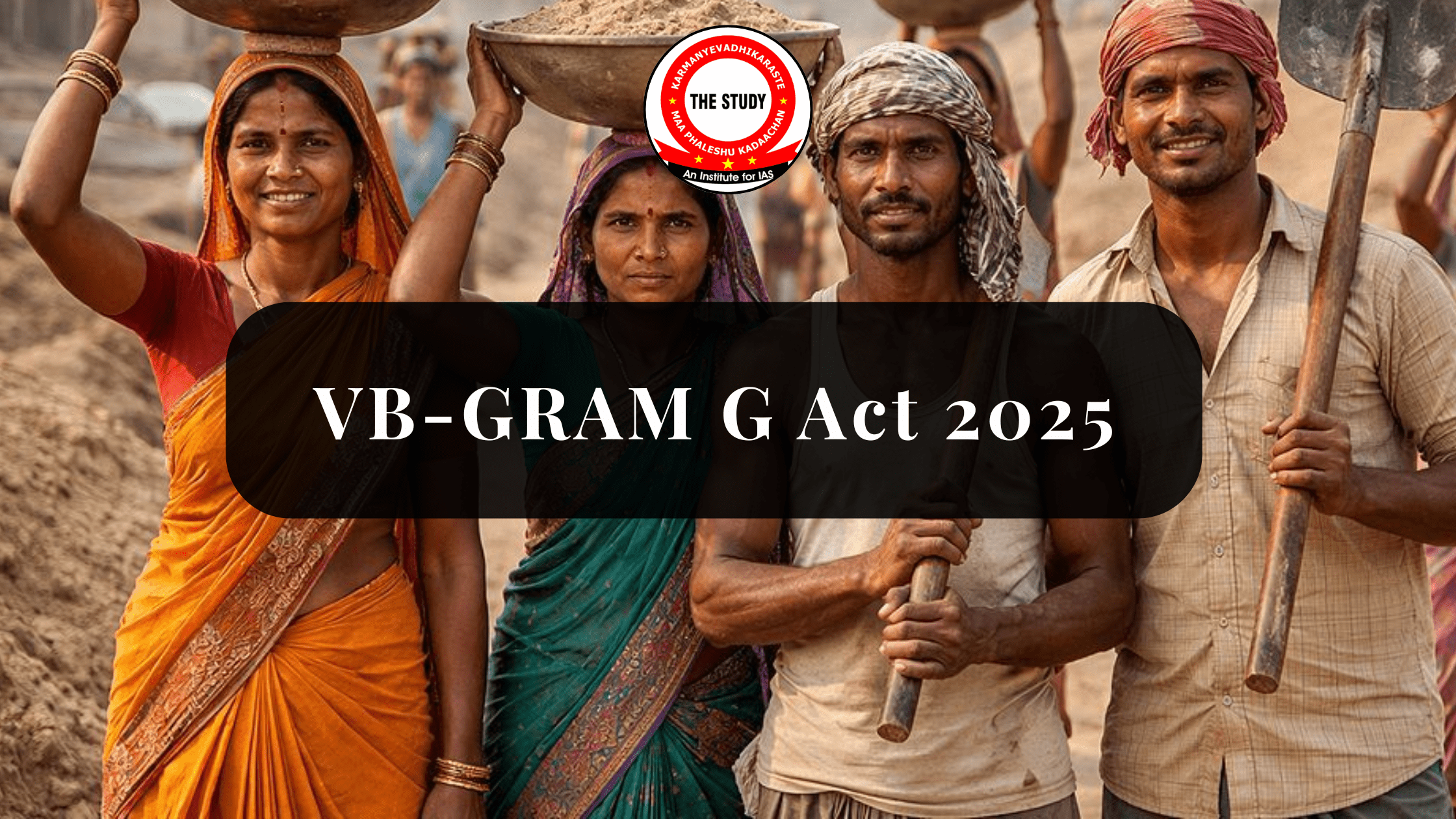
VB-GRAM G Act 2025 Explained: Key Features, Impact, Differences from MGNREGA & What It Means for Rural India
The Government of India has introduced the Viksit Bharat — Guarantee for Rozgar and Ajeevika Mission (Gramin) Act, 2025, popularly known as the VB-GRAM G Act, marking one of the biggest reforms in rural employment policy since the introduction of the Mahatma Gandhi National Rural Employment Guarantee Act (MGNREGA), 2005.
As per the gazetted notification issued on May 11, MGNREGA will officially cease to operate from July 1, 2026, and the new framework under the VB-GRAM G Act will take effect nationwide.
This transition is positioned as part of the broader Viksit Bharat @2047 vision, aiming to modernize rural employment systems, improve accountability, strengthen infrastructure creation, and integrate technology-driven governance into rural development.
What is the VB-GRAM G Act, 2025?
The Viksit Bharat — Guarantee for Rozgar and Ajeevika Mission (Gramin) Act, 2025 is a new statutory framework designed to replace MGNREGA and redefine rural employment generation in India.
Unlike MGNREGA, which primarily focused on a rights-based employment guarantee, the VB-GRAM G Act adopts a more integrated developmental approach by combining:
- Rural employment generation
- Livelihood security
- Infrastructure development
- Climate resilience
- Technology-enabled governance
- Convergence-based planning
- Income enhancement strategies
The Act seeks to transform wage employment schemes from welfare-oriented programs into productivity-linked rural development instruments.
Why Was the VB-GRAM G Act Introduced?
The government states that the existing MGNREGA framework required modernization to align with:
- India’s long-term economic transformation goals
- Rural infrastructure demands
- Technological advancements
- Fiscal accountability
- Climate adaptation priorities
The VB-GRAM G Act aims to ensure that employment generation also contributes to:
- Durable public asset creation
- Integrated rural infrastructure
- Agricultural productivity
- Sustainable development
- Village-level economic resilience
Key Features of the VB-GRAM G Act 2025
1. Enhanced Rural Employment Guarantee
One of the most significant reforms under the Act is the expansion of the statutory annual wage employment guarantee.
The government claims this will:
- Strengthen livelihood security
- Increase rural purchasing power
- Improve income stability
- Reduce seasonal distress migration
The revised framework intends to provide more structured and predictable employment opportunities compared to previous systems.
2. Shift from Rights-Based to Normative Allocation System
Under MGNREGA, employment was demand-driven and legally guaranteed.
Any eligible rural household could demand work, and the government was legally obligated to provide employment within a specified time.
The VB-GRAM G Act changes this approach fundamentally.
New Normative Allocation Model
The new framework introduces:
- Centrally determined allocations
- Budget-linked employment ceilings
- Priority-based resource distribution
- Performance-oriented implementation
This means employment availability may depend more on approved allocations rather than open-ended legal entitlement.
Implications
Supporters argue this improves:
- Fiscal discipline
- Resource efficiency
- Targeted implementation
Critics may raise concerns regarding:
- Reduced legal enforceability
- Limited universal access
- Potential exclusion risks
3. Strong Focus on Rural Infrastructure Development
The Act integrates employment generation with infrastructure creation.
Projects under VB-GRAM G will be linked to the:
- Viksit Bharat National Rural Infrastructure Stack
- PM Gati Shakti planning ecosystem
- National spatial infrastructure systems
Infrastructure Priorities Include
- Rural roads
- Water conservation systems
- Irrigation infrastructure
- Climate-resilient assets
- Rural logistics
- Community infrastructure
The government intends to ensure that wage employment simultaneously creates productive long-term assets.
4. Technology-Driven Governance Framework
A defining feature of the new Act is the extensive use of technology for governance and monitoring.
Key Technological Measures
- Biometric authentication
- Geospatial tracking
- AI-driven fraud detection
- Digital attendance systems
- Centralized data integration
- Real-time monitoring dashboards
The government believes this will reduce leakages, improve transparency, and enhance accountability.
However, concerns may arise regarding:
- Digital exclusion
- Connectivity challenges
- Aadhaar-linked authentication issues
- Rural technological accessibility
5. Revised Financial Federalism Structure
The Act modifies the funding structure between the Centre and States.
Funding Pattern
- General States: revised burden-sharing model
- North-Eastern & Himalayan States: 90:10 Centre-State ratio
This restructuring is intended to:
- Encourage state participation
- Improve fiscal accountability
- Balance regional disparities
However, several States may face increased financial responsibilities under the revised mechanism.
6. Climate Resilience and Sustainable Development
The VB-GRAM G Act introduces climate resilience as a core planning component.
Focus Areas
- Water conservation
- Soil restoration
- Drought mitigation
- Flood resilience
- Green rural infrastructure
- Sustainable land management
This aligns rural employment policy with India’s environmental and sustainability commitments.
VB-GRAM G vs MGNREGA: Major Differences
Difference Between MGNREGA and VB-GRAM G Act
- MGNREGA is a rights-based employment guarantee scheme that mainly focuses on providing wage employment to rural households, while the VB-GRAM G Act follows a normative allocation system aimed at integrated rural development.
- In terms of governance, MGNREGA works through a decentralized structure with strong involvement of Panchayati Raj Institutions, whereas the VB-GRAM G Act emphasizes technology-enabled centralized governance.
- MGNREGA gives relatively less emphasis to infrastructure creation and mainly focuses on employment generation, while the VB-GRAM G Act promotes strong infrastructure convergence along with rural development projects.
- Technology usage under MGNREGA is moderate, but the VB-GRAM G Act integrates advanced tools such as AI, geospatial mapping, and biometric systems for monitoring and implementation.
- MGNREGA is largely demand-driven, meaning employment is provided when rural households demand work. In contrast, the VB-GRAM G Act follows an allocation-driven approach where resources and projects are distributed according to predefined norms.
- Climate integration in MGNREGA is limited, whereas climate resilience and sustainability form a core policy component of the VB-GRAM G Act.
- Funding under MGNREGA follows a traditional fiscal structure between the Centre and States, while the VB-GRAM G Act proposes a revised fiscal burden-sharing model.
What Happens to Existing MGNREGA Workers?
The government has assured continuity during the transition.
Important Transitional Provisions
Existing Works Will Continue
All ongoing MGNREGA projects active as of June 30, 2026, will continue under the new framework.
Job Cards Will Remain Valid
Existing e-KYC verified MGNREGA job cards will remain valid temporarily.
These will later be replaced by: Gramin Rozgar Guarantee Cards
No Employment Denial Due to Pending e-KYC
Workers awaiting e-KYC verification will not be denied employment during the transition period.
Potential Benefits of the VB-GRAM G Act
Improved Infrastructure Creation
The convergence model could create more durable and economically productive rural assets.
Better Transparency
Technology integration may reduce corruption and ghost beneficiaries.
Stronger Climate Preparedness
The focus on sustainable rural infrastructure can improve climate resilience.
Integrated Rural Development
The Act attempts to combine welfare with long-term economic productivity.
Challenges and Concerns
Reduced Legal Entitlement
The move away from a rights-based guarantee may reduce legal protection for workers.
Increased State Financial Burden
States may face budgetary stress under revised funding arrangements.
Digital Divide Risks
Biometric and AI-based systems may create exclusion risks in rural areas with weak digital infrastructure.
Centralization Concerns
Greater central oversight may reduce local flexibility and decentralized decision-making.
Key Takeaways
- The VB-GRAM G Act 2025 will replace MGNREGA from July 1, 2026.
- The Act aligns rural employment policy with the Viksit Bharat @2047 vision.
- It shifts from a rights-based employment guarantee to a normative allocation framework.
- Strong emphasis is placed on:
- Infrastructure creation
- Technology-driven governance
- Climate resilience
- Rural productivity
- Existing MGNREGA workers and projects will transition into the new framework.
- The Act may significantly reshape rural employment, fiscal federalism, and development planning in India.
Conclusion
The VB-GRAM G Act 2025 represents a transformative shift in India’s rural employment and development policy landscape. While it promises modernization, infrastructure growth, technological transparency, and climate-oriented planning, it also raises important debates around legal entitlement, federal financing, and digital inclusivity.
As India transitions from MGNREGA to VB-GRAM G, the effectiveness of the new framework will ultimately depend on implementation quality, state capacity, technological accessibility, and its ability to protect vulnerable rural workers while driving sustainable rural transformation.
FAQs on VB-GRAM G Act 2025
What is the full form of VB-GRAM G?
VB-GRAM G stands for Viksit Bharat — Guarantee for Rozgar and Ajeevika Mission (Gramin).
When will MGNREGA end?
According to the gazetted notification, MGNREGA will cease to operate from July 1, 2026.
Is the VB-GRAM G Act replacing MGNREGA?
Yes. The VB-GRAM G Act, 2025 officially replaces MGNREGA as India’s new rural employment framework.
What is the biggest change under VB-GRAM G?
The biggest change is the shift from a rights-based employment guarantee to a centrally allocated normative employment framework.
Will existing MGNREGA job cards remain valid?
Yes. Existing e-KYC verified job cards will remain valid until new Gramin Rozgar Guarantee Cards are issued.
Will workers lose employment during the transition?
The government has stated that workers will not be denied employment due to pending e-KYC verification during the transition period.
How does VB-GRAM G use technology?
The Act introduces:
- Biometric authentication
- AI-driven fraud detection
- Geospatial tracking
- Digital monitoring systems
to improve transparency and accountability.
What is the role of climate resilience in the Act?
Climate resilience is a core feature of the Act, with projects focusing on water conservation, sustainable infrastructure, and environmental restoration.
How is VB-GRAM G different from MGNREGA?
MGNREGA focused mainly on guaranteed wage employment, while VB-GRAM G integrates employment with infrastructure creation, technology governance, and long-term rural development goals.
Related Topics :
• Index of Service Production (ISP)
• CDSCO: Role, Challenges, and Digital Drugs Regulatory System (DDRS)
• Rights of Persons with Disabilities (RPwD) Act, 2016
• Supreme Court Judge’s Strength
• Chief Minister Resignation Rules Under the Indian Constitution
• Indian Navy Maritime Security Strategy 2026 Explained
Subscribe to our YouTube Channel for more Valuable Content – TheStudyias
Download the App to Subscribe to our Courses – Thestudyias
The Source’s Authority and Ownership of the Article is Claimed By THE STUDY IAS BY MANIKANT SINGH
Comments (0)
Leave a Comment