Memory Chips: Meaning, Types, Importance and India’s Manufacturing Push
16 Jun 2026
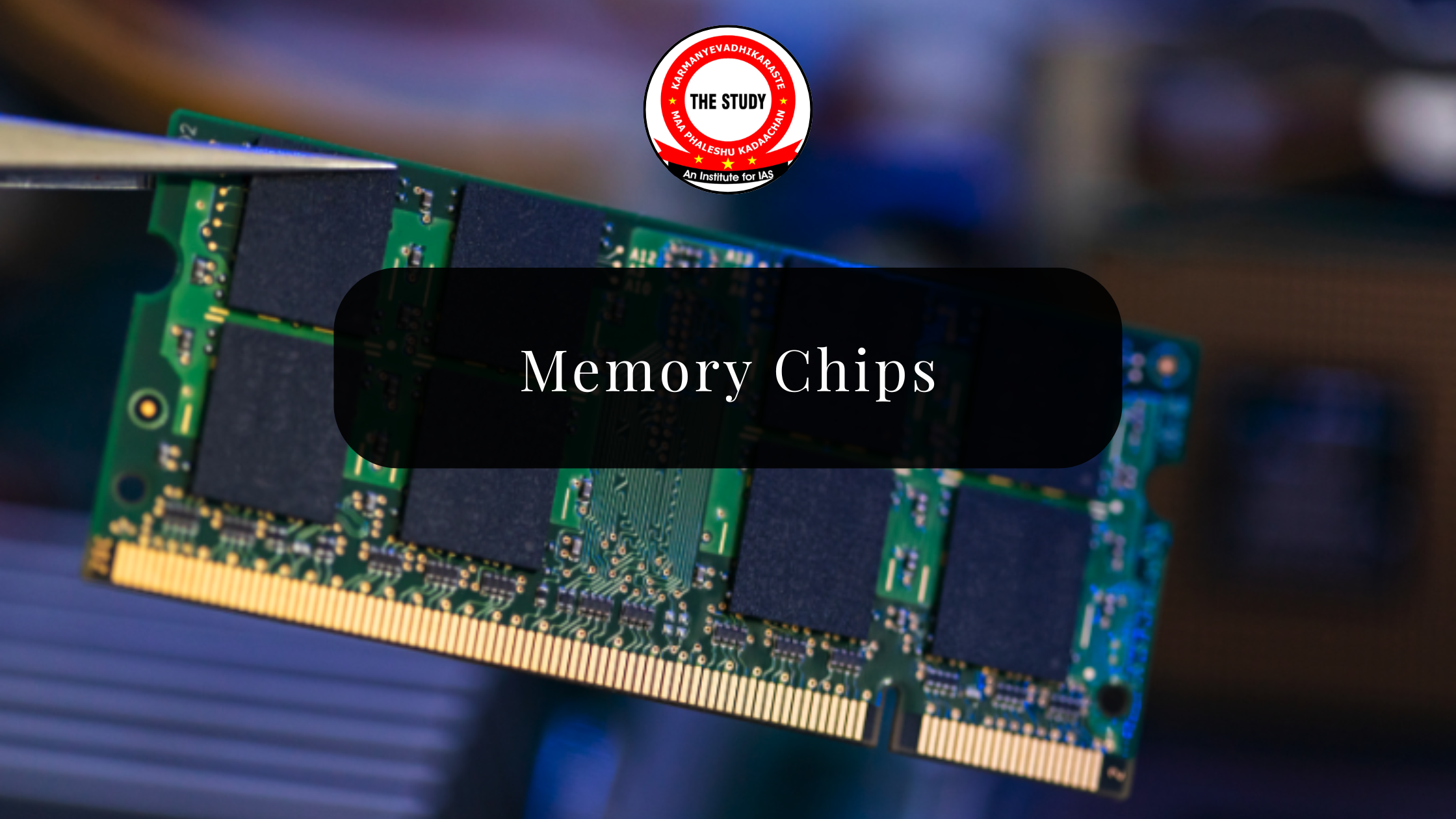
Memory Chip
Context: New companies are likely to invest in India to manufacture memory chips while existing investors will scale up production to address the demand-supply gap in the segment, Union Minister Ashwini Vaishnaw said.
What are memory chips?
- Memory chips are semiconductor devices that use electronic circuits to store digital information, serving as the cornerstone of the information age.
- They are essential components in nearly all electronic devices, from industrial control systems to cloud computing servers, smart terminals, and AI infrastructure.
- These chips are part of the broader integrated circuit (IC) family, which makes up over 80% of the semiconductor industry, with memory chips representing the largest branch of the IC market.
- Memory chips are broadly classified into two types: volatile and non-volatile memory.
- Volatile memory requires continuous power to retain data and includes Dynamic Random Access Memory (DRAM) and Static Random Access Memory (SRAM).
- Non-volatile memory can preserve data even after power is removed, with Flash memory—subdivided into NAND and NOR types—being the dominant form.
- The global semiconductor memory market is dominated by DRAM and NAND Flash.
Why are they essential?
- Powering Everyday Electronics: Memory chips are crucial for the production of consumer devices including smartphones, laptops, tablets, and wearables. For a mid-range smartphone, memory can represent 15-20% of the total bill of materials (BOM), while for a high-end flagship device, it can be even higher.
- Enabling AI and Data Centres: The explosive growth of generative artificial intelligence has dramatically increased demand for memory chips. AI systems require massive amounts of high-speed memory, with a newer AI chip using 7.2 times more HBM than earlier generations, and a full system using about 65 times more.
- Fuelling a Global Shortage: The global semiconductor ecosystem is experiencing an unprecedented memory chip shortage that began in late 2025 and could persist well into 2027.
- Impacting the Broader Economy: The higher memory chip prices have led to a rise in production costs for a range of electronic products, including smartphones and laptops.
What measures have been taken to augment the production of memory chips in India?
- Financial and Policy Support: The Semicon India Programme (₹76,000 crore) provides 50% fiscal support for ATMP/OSAT facilities; ₹22,500 crore for Micron; ₹3,700 crore for HCL-Foxconn JV.
- Flagship Manufacturing Facility: Micron Technology’s $2.75 billion ATMP plant in Sanand, Gujarat - India’s first commercial semiconductor assembly facility, inaugurated in February 2026.
- Planned Expansions by Global Leaders: SK Hynix in preliminary talks to set up a memory chip assembly and testing facility; HCL Group-Foxconn JV (₹3,700 crore) for OSAT facility in Greater Noida.
- Indigenous Manufacturing Initiatives: MiPhi Semiconductors (JV of Micromax & Taiwan's Phison) focused on AI-driven NAND SSDs designed and manufactured in India.
- Future-Focused Policy Direction (ISM 2.0): Prioritises chip design, local manufacturing of semiconductor equipment, HBM packaging for AI data centres, talent development, and extending support to supply chain players.
Related posts :
- Majoritarianism vs Constitutionalism
- India-Bangladesh Ties
- Nordic Countries and India
- Tackling Ocean Plastic Pollution
- India-Bhutan Ties
- India-UAE Ties
- India-Netherlands Ties
- Captagon: The “Jihadi Drug”
- Bioenergy Systems
- Transforming the Brahmaputra
- India–Africa Forum Summit
- India–US Defence Ties
Subscribe to our YouTube Channel for more Valuable Content – TheStudyias
Download the App to Subscribe to our Courses –Thestudyias
The Source’s Authority and Ownership of the Article is Claimed By THE STUDY IAS BY MANIKANT SINGH
Comments (0)
Leave a Comment